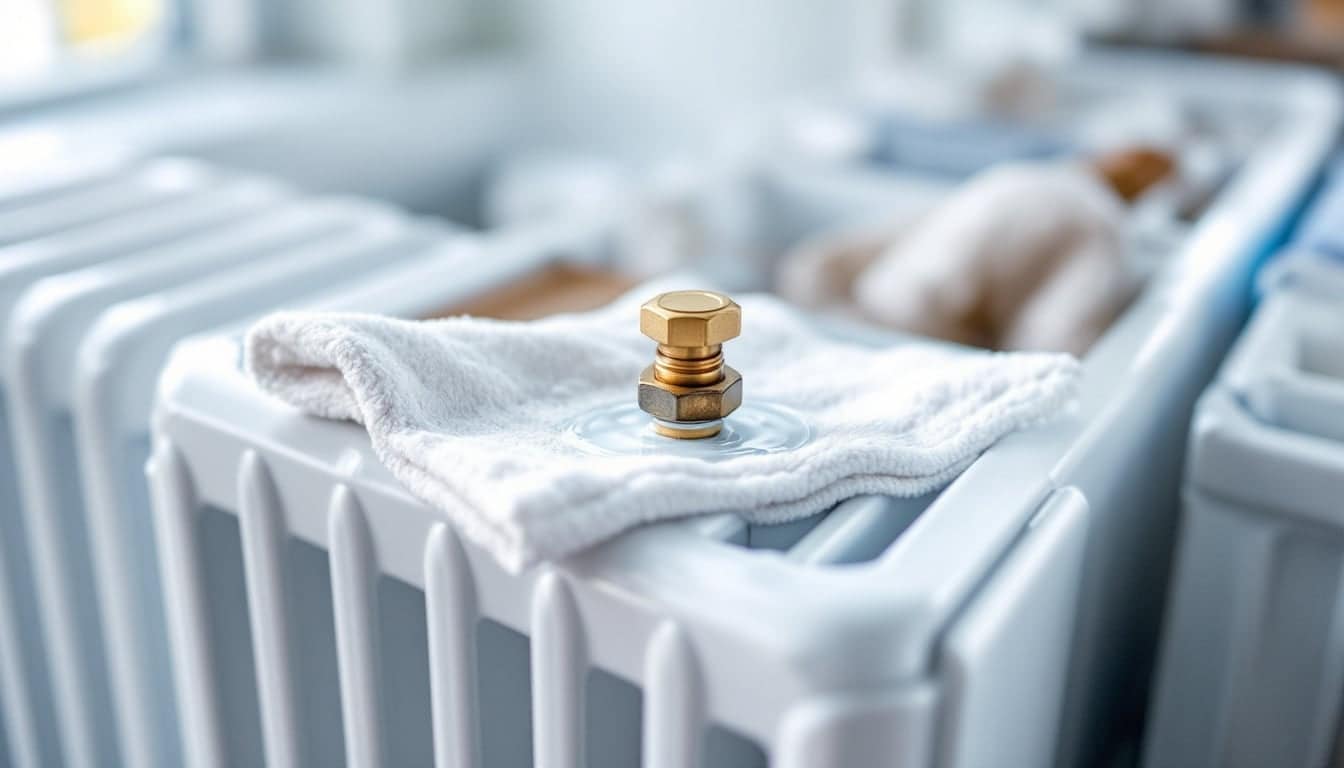
The first cool evening of the season is when most people find out which radiators have air in them. The heating comes on, the pipes tick as they warm, and one radiator stays stubbornly cool along its top edge while the bottom gets hot. Bleeding it takes a few minutes and a small key. Doing it in the right order, putting the pressure back afterwards and asking why the air arrived in the first place are what turn a quick fix into a lasting one.
This guide covers all three. More on looking after radiators and combi boilers sits in the radiator cleaning and combi boiler care section.
Some tool links earn us a commission. As an Amazon Associate I earn from qualifying purchases.
Why air ends up at the top of a radiator
Picture a radiator as a flat metal tank standing on its edge, with a pipe at each bottom corner. Hot water comes in at one corner, spreads through the panel and leaves at the other. Air is lighter than water, so any bubbles carried round the system float upwards until they meet a ceiling they can't pass. In a radiator, that ceiling is the top seam. The bubbles gather there into a pocket, and hot water simply can't reach the part of the panel the air is occupying.
That is why trapped air shows up as a cold band along the top. The band starts thin and grows as more air collects. On a badly airlocked radiator, only the bottom third may get warm.
Signs a radiator needs bleeding
- Cool top, warm bottom. After twenty minutes of heating, run your hand up the radiator's face: a clear line where warm becomes cool is the classic sign.
- Gurgling or trickling. Water moving past air pockets sounds like a small stream, often loudest just after the pump starts.
- Upstairs worse than downstairs. Air drifts to the highest points in the system, so top-floor radiators and towel rails tend to collect most of it.
- A slow warm-up in one room while the others are comfortable.
Other cold patterns mean other things. A radiator that is warm at the top and cold along the bottom is usually holding sludge, which bleeding won't shift; the guide to radiator flushing deals with that one. A radiator that is cold all over, with the rest of the house fine, is more often a closed valve, a stuck thermostatic valve pin or a balancing problem.
Heating off and cool first, and why
Use the heating to find the problem, then switch it off before you bleed. There are three reasons.
First, a running pump keeps air churned through the panel instead of letting it settle at the top. Second, on some systems the pump pulls parts of the circuit slightly below atmospheric pressure. Open a bleed valve there with the pump running and it can draw air in rather than letting it out. Third, heating water is hot enough to scald, and a hot sealed system is at higher pressure, so it spits harder.
Turn the heating off at the programmer or thermostat and wait until the radiators are only warm to the touch; half an hour to an hour is usually plenty. There's no need to switch the boiler off at the wall.
Keys and bleed valves
The bleed valve sits at one of the top corners of the radiator, at the end of the top seam. What you turn it with depends on the type.
- Square spindle. The most common sort: a small square peg inside a round hole, turned with a radiator key. Keys are cheap and best bought in twos, because they vanish.
- Slotted screw. Turned with a flat-bladed screwdriver that fills the slot, so it doesn't chew the edges.
- Towel rails. Usually on top of one upright, often a small hexagon or a slotted screw under a cap.
- Older column and cast iron radiators. Sometimes a plug on top of the end section instead.
Universal keys cover most of these. Never use pliers on a square spindle; they round it off in seconds.
Have ready an old cloth (the water can stain), a small tray or jug, some kitchen paper and a torch for the dark corner behind the curtain.
Bleeding a radiator, step by step
- With the heating running, walk round and note each radiator with a cool top. Then switch the heating off and let the system cool.
- Fold the cloth into a thick pad and hold it right under the bleed valve. Slide the tray or jug beneath to catch drips.
- Fit the key and turn it anticlockwise a quarter of a turn, half a turn at most. Turned too far, the little bleed screw can come right out, and refitting it against a jet of water is nobody's idea of fun.
- Listen. A steady hiss is air escaping. Hold the key and cloth in place.
- When the hiss turns to sputtering and then a steady trickle of water, close the valve clockwise. Firm is enough; overtightening crushes the small seal.
- Wipe the valve dry and check it again in a few minutes. A damp spot needs a fraction more of a nip.
- Move on to the next radiator in your chosen order (see below), watching the boiler's pressure gauge if you have one.
- When you've finished, check the pressure, top up if needed, switch the heating back on and feel each top edge after twenty minutes.
Toolbox
- EasyRadiator bleed keys (5-pack)
Small chrome-plated keys that fit the square spindle on most radiator bleed valves, so a cold-topped radiator can be vented in a minute.
Buy on Amazon - EasyInfrared surface thermometer
Point-and-read surface temperatures, handy for finding the cold patch on a radiator, checking flow and return pipes or an underfloor loop.
Buy on Amazon - Easy8-inch adjustable wrench
A mid-size adjustable wrench for supply nuts, shower heads and compression fittings.
Buy on Amazon
Picked from specifications and published reviews, not tested by us.
If nothing comes out at all, don't open the valve further. The bleed hole may be blocked with paint or debris, the radiator's valves may be closed, or the system pressure may be too low to push anything out.
Which radiator first: two conventions
You'll come across two pieces of advice, and both are right, for slightly different reasons.
Downstairs first, then upstairs. Air rises. If you bleed the top floor first and then disturb air downstairs, the loosened bubbles drift up and you end up bleeding the upstairs radiators twice. Starting low means any air you set moving heads towards radiators you haven't done yet.
Furthest from the boiler first. Radiators at the far ends of the pipe runs see the weakest flow, so air tends to linger there. Working back towards the boiler follows the same logic: whatever you dislodge travels towards radiators still waiting their turn.
In a house on several floors, combine the two: ground floor first, furthest radiator to nearest, then the floor above in the same way, finishing with the highest radiator or towel rail. In a flat or bungalow, simply go furthest to nearest.
There is one more reason to work methodically on a sealed system. Each bleed lets a little water out and the pressure drops. If it falls far enough, the water at the top of the house may no longer be under positive pressure, and opening a top-floor bleed valve can let air in instead of out. Glance at the gauge between radiators and top up before it gets low.
Putting the pressure back
On a sealed system, the usual arrangement with a combi boiler, the water you bled out isn't replaced automatically. Read the gauge with the system cold. Most combi systems sit at roughly 1 to 1.5 bar cold, but the boiler manual has the right figure for yours. If you're below it, top up through the filling loop. The guide to a combi boiler losing pressure walks through the filling loop step by step.
On an open-vented system, with a small feed-and-expansion tank in the loft, the tank refills the circuit by itself through a float valve. After a big bleeding session, check that the float isn't stuck and that the tank still has water in it.
What comes out of the valve
Look at the cloth. Clear or faintly grey water is normal. Black water points to magnetite sludge, and orange-brown water to rust and oxygen getting in; the flushing guide linked above covers both. A long hiss with only a dribble of water at the end, on a sealed system, often means the pressure was already low.
Never hold a lighter or any flame near a bleed valve. Some of the gas inside a corroding system is hydrogen, and it burns.
When bleeding keeps being needed
A radiator that needs a two-second bleed at the start of each winter is behaving normally. One that hisses for half a minute every fortnight has a cause, and it's worth finding.
Air getting in
Air can enter wherever part of the circuit runs below atmospheric pressure. Tiny gaps that would weep water outwards under positive pressure draw air inwards instead: a worn valve gland, a joint with a hairline gap, a sticking automatic air vent. On a sealed system, running at low pressure makes this more likely, which is another reason to keep the gauge in its normal range.
Frequent topping up adds air too: fresh mains water carries dissolved air, which comes out as bubbles once the water heats.
Gas from corrosion
Steel radiators corroding from the inside produce gas as well as sludge. If the same radiators need bleeding every week or two and the water that comes out is dark, corrosion is a more likely source than a leak. Bleeding treats the symptom. A cleaner system with the correct dose of inhibitor treats the cause.
Pump position and speed
On open-vented systems, where the pump sits in relation to the cold feed and the open vent pipe matters a great deal. Get it wrong and the pump can pull air in through the vent, or push water up and out of it into the loft tank, known as pumping over. Signs include water splashing into the tank when the heating starts, or constant air in the radiators nearest the pump.
On any system, a pump set too fast keeps air whipped up; one set too slow may not carry it round to where it can escape. Pump settings and pipe layout are for a heating engineer, but the pattern you've noticed will help them.
Automatic air vents
Many systems have a small automatic air vent at a high point or on the pump, sometimes inside the boiler. Stuck shut, it leaves air in the radiators; stuck open, it lets water out. One inside the boiler casing is for an engineer only.
Keep a short note of which radiators you bled, the date and roughly how long each one hissed. Two or three entries tell an engineer more than any description from memory.
Tools for this job Toolbox: Radiators and boilers

Selin Aydemir
Selin writes about central heating: combi boilers, radiators, underfloor loops and the small habits that keep a sealed system running quietly. She likes explaining why a fault happens before saying what to do about it.
General guidance only. Gas, electrical and structural work must be done by a suitably qualified person, and rules differ from country to country.


