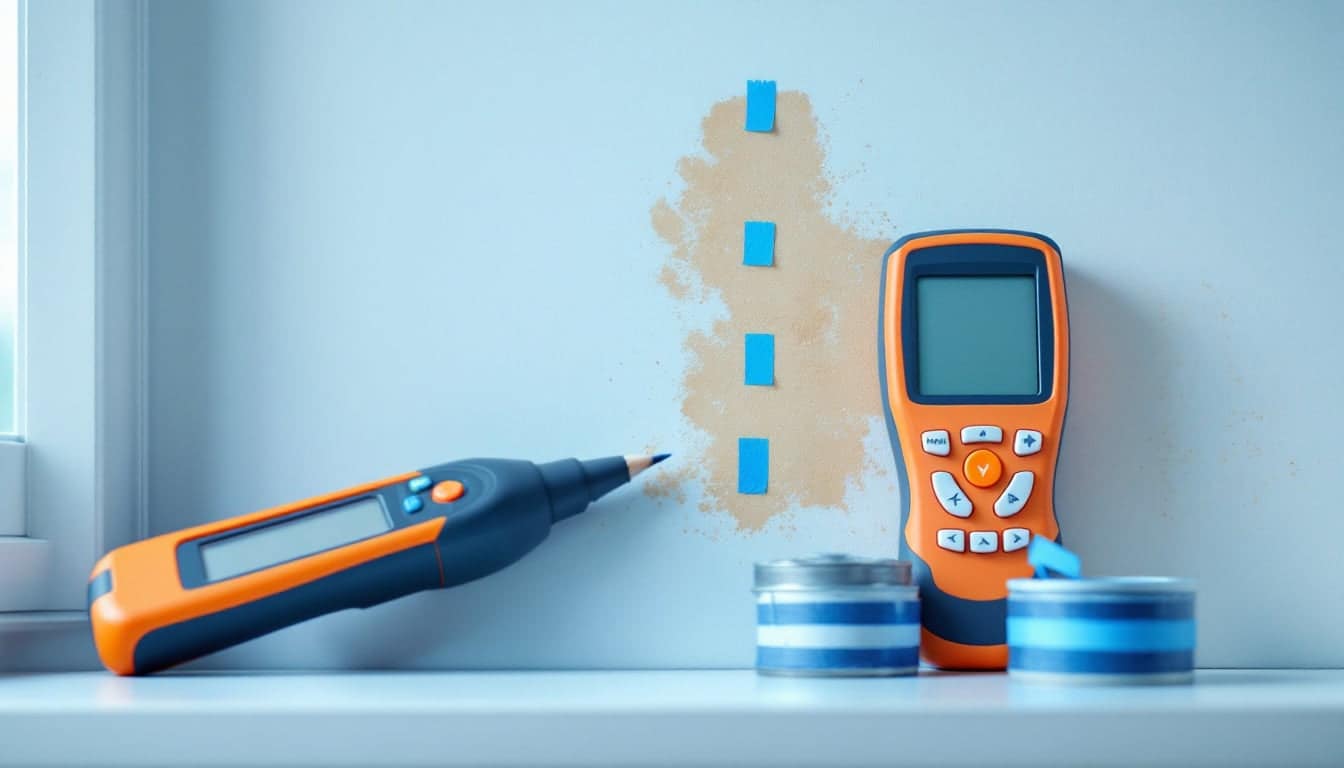
A moisture meter is one of the few leak-hunting tools a homeowner can use well after a little practice. It will not show you a pipe or point at a dripping joint. What it does, used patiently, is measure how far water has spread through drywall or timber, which way it is moving, and whether a patch is getting wetter or drying out. That is often enough to separate a weeping supply line from a failed shower seal, and enough to give a plumber a sensible place to start.
Below: the two kinds of meter, how to read drywall and timber without being misled by the numbers, how to map a damp patch, and when any meter gives a wrong answer. If you are not yet sure there is a leak at all, do the water meter leak test first.
Pin vs pinless moisture meters
A pin-type meter has two short steel pins on top. You push them into the material and the meter passes a small current between them. Water conducts far better than dry wood or gypsum, so the lower the resistance, the higher the reading. It measures only what lies between the pin tips, and it leaves two small holes each time.
A pinless meter has a flat sensor pad on the back. Pressed against a surface, it reads a zone underneath using a weak electromagnetic field. The depth of that zone is fixed by the design and stated in the instructions; on many models it is roughly 3/4 inch (19 mm). There are no holes, so you can sweep a painted wall in a few minutes and watch where the numbers rise.
| Pin-type meter | Pinless meter | |
|---|---|---|
| How it reads | Resistance between two pins | Field under a flat pad |
| Depth | As deep as the pins go | A fixed zone below the surface |
| Strongest on | Timber: baseboards, studs, door casings | Drywall, painted plaster, finished floors |
| Commonly fooled by | Salts, surface water, the wrong wood setting | Metal behind the surface, dense materials |
The best moisture meter for drywall and walls
For finding the edges of a damp patch on drywall, a pinless meter is the quicker first tool. It covers ground fast and leaves no marks on a wall you may want to keep. The pin meter earns its place when you need a figure you can trust in timber, or a second opinion where the pinless meter might be reacting to something other than water. Leak specialists usually carry both.
When choosing, look for a display that holds a reading, material or wood-group settings, a relative mode for drywall and masonry, and a built-in self-check. Replaceable pins are worth having, because pins bend. A battery leak alarm completes the kit: once a repair is done, it sits on the cabinet floor and tells you about the next drip on the day it happens.
Reading drywall and timber
Percentage scales and relative scales
On timber, a pin meter set to the right wood group reports moisture content as a percentage: the weight of water in the wood compared with the weight of the same wood when completely dry. Interior trim in a heated home usually sits in the single figures or low teens. Framing lumber sold as dry is graded at 19 per cent or less, and timber that stays wetter than about 20 per cent for weeks is at risk of mould and, in time, rot. That makes timber the most honest witness in the room.
Drywall is different. Gypsum holds very little water when dry, so a wood-scale percentage is not the water content of the board. Many meters offer a reference mode, a plain 0 to 100 scale with no units, and some have a drywall setting. Treat the number as a comparison and nothing more. The same applies to plaster, brick and concrete.
Take reference readings from a dry area first
Before you go near the stain, find a dry reference on the same wall: same material, same paint, the same height if possible, and 3 to 6 feet (1 to 2 metres) clear of any marks. Take four or five readings and write down the range. That range is your baseline. It changes from wall to wall and from summer to winter, which is exactly why you need it.
Readings inside the baseline scatter mean nothing. A cluster well above it, climbing towards one point, means water. Keep the meter in the same mode throughout, press a pinless pad flat with full contact, and push pins to the same depth each time.
Timber around a wet wall
Baseboards are often the best place to read. Water running down inside a wall reaches the bottom plate and soaks into the trim, so a row of pin readings along the baseboard shows where the wet section starts and stops. Push the pins into the top edge, or somewhere furniture will hide, and work along at regular intervals. Door casings and the sides of a sink cabinet help too, though particleboard reads on its own scale, so compare it only with dry particleboard.
Mapping a damp patch to trace a leak
A single reading tells you that a spot is wet. A map tells you where the water is coming from. You need the meter, a pencil, painter's tape and a sheet of paper.
- Record the stain. Photograph it, draw lightly round its edge in pencil and date the line.
- Set your baseline from a dry area, as above.
- Mark a grid. Start at the centre of the stain and mark points every 4 to 6 inches (100 to 150 mm), widening to about 12 inches (300 mm) beyond the visible edge. Keep going until two points in a row read at baseline. Include the ceiling line, the baseboard, and the far side of the wall if a closet or cabinet gives access.
- Write every value on a sketch at its position, low ones included, then join similar values with lines, like contours on a walking map.
- Repeat at the same points at fixed times. Read first thing in the morning after a night without water use. Then run the suspect fixture (a 10-minute shower, a dishwasher cycle, a bath filled and emptied) and read again 30 to 60 minutes later, and the next day.
- Compare with the water meter. If the house meter moves with everything off, a pressurised pipe is leaking somewhere, whatever the wall says.
What the shape tells you
- Wettest at the bottom, narrowing upwards: water running down the cavity from above. Look at what sits over that wall: a shower valve, a toilet, supply lines in the floor.
- Wettest in the middle, fading evenly: a source close behind that point, such as a weeping fitting.
- A long band along the base of a wall: water spreading across a slab or subfloor, often from a pipe in the floor. On masonry ground floors, rising damp can look similar.
- Wetter after one fixture is used, drying in between: a drain, seal or waste connection rather than a pressurised pipe.
- Getting wetter with no water used at all: a supply or heating pipe under pressure around the clock.
Water rarely stays where it starts. It runs along joists, down studs and across slabs, so the wettest point may be a few feet from the leak. The contours show which way is upstream, and that direction is the useful part. Moisture mapping is one stage of a professional survey; electronic leak detection explained shows how it fits alongside thermal imaging, acoustic listening and tracer gas.
When a moisture meter misleads
Salts
Plaster, brick and old drywall that have been wet before can hold salts left behind as the water dried. Salts conduct, so a pin meter reads them as moisture, and some pull water from humid air and really do dampen the surface on muggy days. The giveaway is a high reading that never changes, whatever water you use, sometimes with a white powdery bloom on the paint. On old plaster, trust timber readings and the trend over time more than any single number.
Metal behind the wall
A pinless meter reacts to anything conductive in its range: corner bead, drywall screws, steel nail plates over pipes, metal studs, foil-faced insulation, copper pipe close behind the board. Older homes may have metal lath under the plaster, lifting readings across a whole wall. A high reading in a neat vertical line, repeated every 16 or 24 inches (400 or 600 mm), is almost always framing or fixings. Check suspicious spots with pins.
Surface condensation
Cold surfaces collect a film of condensation: exterior walls on winter mornings, the wall behind a wardrobe, drywall over a cold-water pipe in humid summer weather. The meter reads that film as damp. Readings that are high first thing and lower by the afternoon, or that drop after the surface is wiped and left for an hour, point to condensation. A sweating pipe inside a wall can even stain the board without leaking a drop, and only the water meter will tell you which it is.
Tile, stone and concrete
Dense materials give high or meaningless readings on a pinless meter, and pins cannot get into tile at all. On a tiled shower wall, read the drywall or cabinet on the other side instead.
One safety point covers all of this: keep pins away from outlets and switches, and from the line straight above and below them, where cables usually run. If readings are high around an outlet, switch that circuit off at the breaker and leave it alone.
What readings mean and what they don't
| What you see | What it can mean | What it does not prove |
|---|---|---|
| Stain visible, readings at baseline | An old stain, or a leak that runs only sometimes | That there is no leak |
| High cluster rising after one fixture is used | A drain or seal on that fixture | Which fitting is at fault |
| High cluster rising with no water in use | A leaking pressurised pipe | Where on the pipe |
| High readings that never change | Salts or old damage | That the wall is wet today |
| Readings falling after a repair | The surface is drying | That the framing is dry |
After a repair, keep reading the same grid points every few days. Insulation and bottom plates dry last, and painting or closing up a wall while the timber behind it is still wet seals the moisture in. Wait until readings are back at baseline.
Keep the dated sketches with the photos. A plumber or leak detection technician can do far more with a map showing how a patch changed over a week than with one number from one afternoon, and the water leak detection hub covers the next steps once you know roughly where to look.
Tools for this job Toolbox: Leaks and damp

Kerem Yalçın
Kerem covers leaks, damp and the detective work in between: meter tests, moisture readings and the non-destructive methods used to find a leak without opening every wall.
General guidance only. Gas, electrical and structural work must be done by a suitably qualified person, and rules differ from country to country.


