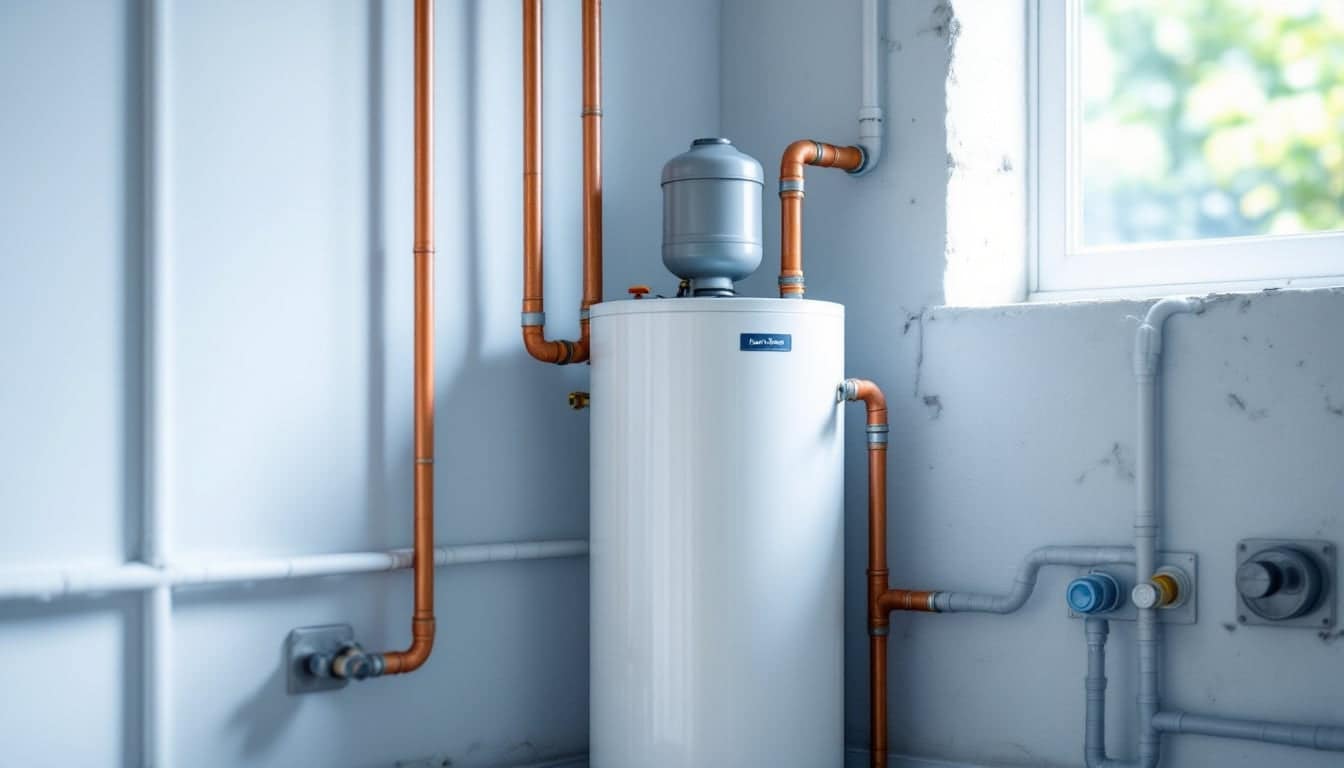
Water heater replacement cost depends less on the heater itself than on everything around it. Two households can choose the same 50 gallon (189 litre) tank and receive very different quotes, because one is a straight swap in a dry basement with easy access, while the other needs a new vent connector, an expansion tank, a longer gas line and a permit inspection that flags three outdated details.
You will not find dollar figures here. They change with region, season and the state of the existing installation. What stays the same is the list of things behind the number, and once you know it, two quotes become much easier to compare.
Some links earn us a commission.
Repair or replace: decide this first
Plenty of hot water problems come from parts that are inexpensive and quick to change. Before anyone measures for a new tank, match the symptom to its likely cause.
| What you see or hear | What it usually means | Repair or replace |
|---|---|---|
| Water pooling under the tank, traced to the shell or base seam | The inner steel tank has corroded through | Replace; a tank leak cannot be sealed |
| A drip from the drain valve at the bottom | Worn washer, grit on the seat, or a cracked plastic valve | Repair |
| Water from the relief valve discharge pipe | Pressure or temperature too high, or a tired valve | Repair, then find the cause |
| Brown or rusty water from hot taps only | The anode rod is used up and the tank lining is rusting | Repair if young; replace if old |
| Rust and damp around the pipe fittings on top | Corroded nipples or connectors | Usually repair |
| No hot water from an electric heater | Failed element, thermostat or tripped high-limit reset | Repair |
| No hot water from a gas heater | Thermocouple, flame sensor, igniter or gas valve | Repair, by a qualified technician |
| Rumbling and popping while heating | Sediment on the tank floor | Flush; replace only if it keeps returning on an old tank |
| Hot water runs out much sooner than it used to | Broken dip tube, a dead lower element, or a household that has outgrown the tank | Repair, or size up |
To trace a leak, dry every fitting, lay kitchen paper around the base and come back in an hour. Water on the paper with every fitting still dry is coming from the tank.
Age and the serial number
Tank water heaters are commonly expected to last somewhere around 8 to 12 years, often less where the water is hard and the tank has never been flushed. The manufacture date is coded into the serial number on the rating plate. Makers use different formats, but a letter or two digits for the month and two digits for the year are common, and the maker's own support material explains how to read theirs.
Age changes the arithmetic of a repair. A new thermostat on a three-year-old tank is an easy yes. On a twelve-year-old tank it fixes today's fault and does nothing for steel that has been corroding for a decade, so many owners replace on their own timetable instead.
Leaks and rust from the tank itself
This verdict is never in doubt. Water weeping from the shell, the base or under the insulation jacket means the lining and the steel behind it have failed. Close the cold valve on top, switch off the breaker or set the gas control to off, and plan the replacement.
What sets the water heater replacement cost
Tank size and first-hour rating
Like for like is the simplest quote; going up a size can mean a tank that no longer fits the closet, a bigger burner or new venting. Before assuming you need more gallons, look at the first-hour rating (FHR) on the yellow EnergyGuide label. It is the amount of hot water a heater can deliver in one busy hour starting from full, and it reflects how a household really uses hot water far better than tank volume does.
Here is how the sum works for a family of four with a busy morning. Four showers at about 10 gallons each, one shave with the tap running at about 2 gallons, and one dishwasher load at about 6 gallons come to 48 gallons (182 litres) in the peak hour. That household should look for an FHR of at least 48 gallons. The water heater size calculator runs the same sum with the US Department of Energy's per-use figures, so you can try your own busiest hour.
Water heater replacement cost for a 50 gallon tank
A 50 gallon tank is the usual size for three or four people and the quote plumbers write most often. Two things push it up. US efficiency rules introduced in 2015 made many tanks wider and taller because of thicker insulation, so a new 50 gallon unit may not slide into the space the old one occupied. And a gas 50 gallon tank usually has a higher FHR than an electric one of the same volume, because the burner reheats faster than the elements; some owners switching fuel find they need a larger electric tank to keep the same comfort.
Gas water heater replacement cost
Gas jobs carry more line items because there is more to check: flue diameter and slope, the vent connector, combustion air, the gas shutoff valve and sediment trap, and a leak check on every joint after lighting. A power-vented tank adds a fan, plastic vent pipe through a wall and an outlet. Gas work is always for a licensed professional, under rules set by your state and town.
Fuel type in general terms
- Electric tank. The simplest to fit: water connections and a 240 volt circuit. Slower to reheat than gas.
- Gas tank. Quicker recovery, but it needs a gas supply, a vent and air for combustion.
- Heat pump water heater. An electric tank with a small heat pump on top that draws heat from the surrounding air. Much cheaper to run than a standard electric tank but dearer to buy; it needs space and air around it, cools its room and needs a condensate drain. Ask what rebates currently apply where you live.
- Tankless. Usually a conversion rather than a replacement, with larger gas or electrical supplies.
Switching fuel is where the quote grows fastest. Gas to electric needs a new circuit and sometimes panel capacity; electric to gas needs a gas line and venting; a heat pump needs the right room.
What the job should include
A clear quote lists each of these, or says why it does not apply:
- Permit and inspection. Many towns require a permit for a water heater replacement. Ask who pulls it and who meets the inspector.
- Draining, removal and haul-away of the old heater.
- Water connections. New flexible connectors, a working cold shutoff valve, and fittings that suit the pipe metal.
- Expansion tank. If the main has a check valve or a pressure reducing valve, heated water has nowhere to expand. A small expansion tank on the cold line absorbs it, and many codes require one in that situation.
- Relief valve and discharge pipe, run full size to a location your code allows.
- Venting for gas units, including any liner or connector the new heater needs.
- Code updates. Seismic straps in states that require them, a drain pan where a leak would damage the floor below, a raised stand in some garages. A heater fitted twelve years ago may have met the rules then and not now, and the inspector looks at the whole installation.
- Start-up. Filling, purging air, lighting or powering up, setting the temperature (about 120 °F (49 °C) is a common choice) and checking every joint.
- Warranties, the maker's on the tank and parts, the installer's on labour, with the length of each written down.
Whatever heater you choose, a battery leak alarm on the floor beside it is a small precaution that catches a slow drip early.
Labour time
A like-for-like tank swap with good access typically takes a plumber about 2 to 4 hours on site, and draining an old, sediment-filled tank can use up an hour of that. Add time for an attic or tight closet, seized fittings, a new vent connector or expansion tank, and any fuel change, which can fill a full day and bring in an electrician. Tankless conversions commonly take a day or more.
Home warranties and what they cover
If you already hold a home warranty, read it before calling anyone, because a home warranty may cover replacement of a failed water heater. Check what the contract excludes, since code upgrades, permits, venting changes and haul-away are often listed separately. Coverage varies between plans, and some states are excluded.
DIY or professional
A like-for-like electric tank swap is within reach of a confident DIYer where local rules let homeowners do it under a permit. Gas is different everywhere: gas connections, venting and combustion air belong to a licensed plumber or gas fitter. When you collect quotes, the guide on how to choose a plumber covers the questions that separate a careful installer from a quick one, and the wider heating and boiler care section explains how hot water fits into the rest of a home's heating.
Before the installer arrives
Clear a path wide enough for a tank on a hand truck. Find the main shutoff and the cold valve on top of the heater, and check both turn. Photograph the rating plate and EnergyGuide label so the installer can match the FHR and fuel type, and measure the space, including any door frame the tank must pass through. If the old tank is leaking, keep the cold valve closed and towels down until the new one is in.
Work it out Water heater size calculator

Selin Aydemir
Selin writes about central heating: combi boilers, radiators, underfloor loops and the small habits that keep a sealed system running quietly. She likes explaining why a fault happens before saying what to do about it.
General guidance only. Gas, electrical and structural work must be done by a suitably qualified person, and rules differ from country to country.