Shop for a salt-free water softener and you'll find plenty of systems sold under that name. Strictly speaking, most of them aren't softeners. A salt-based unit removes the calcium and magnesium that make water hard. A salt-free system leaves those minerals in the water and changes how they behave, so they're less likely to form scale. Both can be the right choice. They just do different jobs, and the price, the plumbing and the upkeep follow from that.
Some tool links earn us a commission. As an Amazon Associate I earn from qualifying purchases.
What you'll need
- Water hardness test stripsEasy
- Water pressure test gauge (hose thread)Easy
- 32,000-grain whole-house water softenerPro
- 48,000-grain whole-house water softenerPro
- Whole-house salt-free scale control systemPro
- Pro32,000-grain whole-house water softener
A smaller salt-based softener for one or two bathrooms and moderate hardness.
Buy on Amazon - Pro48,000-grain whole-house water softener
A salt-based whole-house softener for larger households or harder water; usually professionally installed.
Buy on Amazon - ProWhole-house salt-free scale control system
A salt-free conditioner that reduces scale build-up without removing hardness minerals.
Buy on Amazon
Picked from specifications and published reviews, not tested by us.
This guide sets out how each type works, what each will and won't do, and which homes suit which. Two quick measurements before you start make the rest of it much easier: your water hardness, and your static water pressure at an outside tap.
How a salt-based softener works
A conventional softener uses ion exchange. The main tank is filled with resin beads that carry sodium ions (or potassium, if you use potassium chloride). As hard water flows through, calcium and magnesium cling to the beads and sodium is released in their place. Water leaving the tank tests at or close to zero hardness.
Eventually the beads are full of hardness. The control valve then runs a regeneration, usually at night:
- Backwash. Water flows up through the resin to loosen it and flush out sediment.
- Brine draw. Strong salt solution from the brine tank is pulled through the resin, pushing the calcium and magnesium off the beads.
- Rinse. Fresh water washes the brine and the hardness out to the drain.
- Refill. The brine tank refills so salt can dissolve for next time.
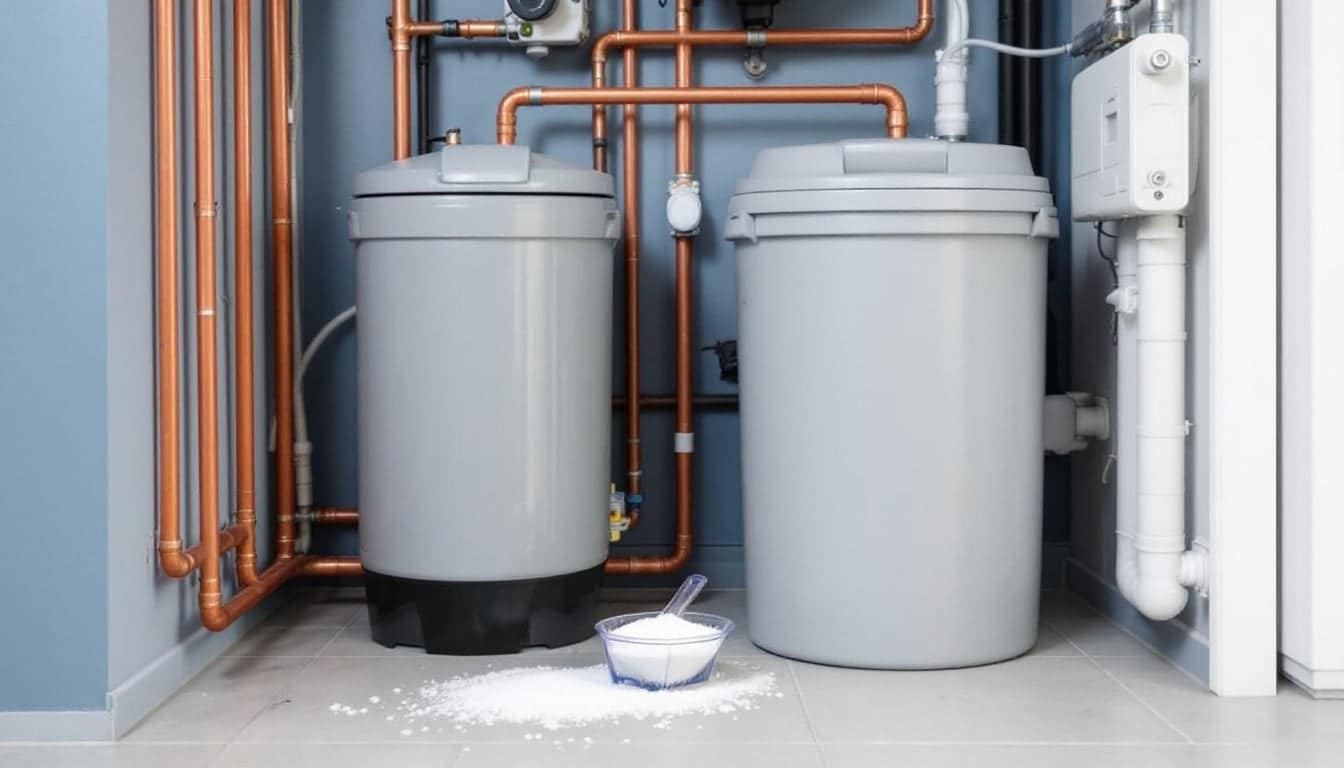
That cycle is why a salt-based softener needs a brine tank, bags of salt, a drain connection and usually an electrical outlet. It's also why it removes hardness completely: the minerals leave the house down the drain. Getting the capacity right matters, because an undersized unit regenerates too often. Our water softener size calculator works it out from household size and hardness.
How salt-free conditioners work
Template-assisted crystallisation (TAC)
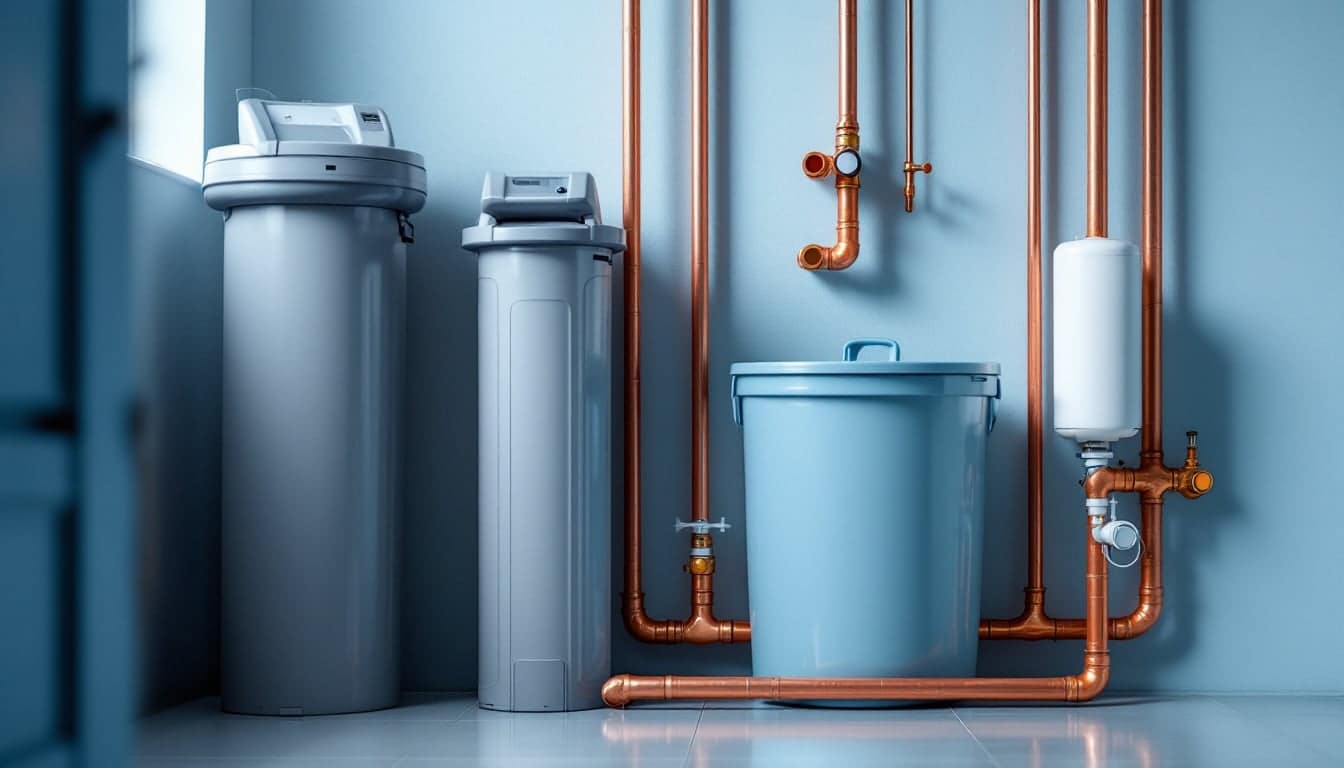
The most common salt-free system is a single tank of specially treated polymer beads. The surface of each bead has tiny sites that act as templates. As water passes through, dissolved calcium and magnesium carbonate gather on those sites and form microscopic crystals, which break away and travel on through the plumbing suspended in the water. Because the hardness is already in crystal form, it's far less inclined to build up as scale on hot surfaces such as water heater elements and the heat exchanger of a tankless heater. You'll also see this sold as nucleation-assisted crystallisation (NAC), which works on the same idea.
The minerals stay in the water. That has three consequences people often don't expect:
- A hardness test strip reads the same after treatment as before.
- Soap and shampoo lather as they did with hard water.
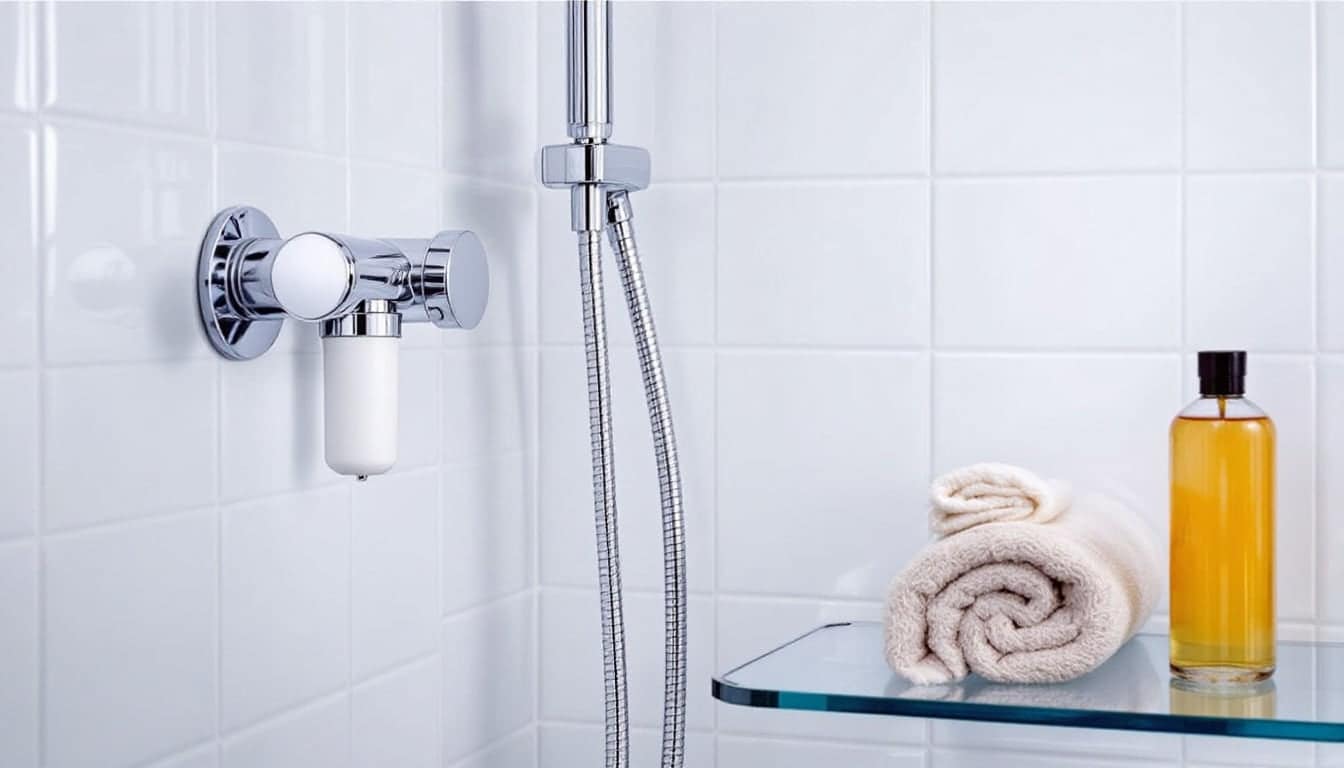
- Where water evaporates, on glass shower screens and dark faucets, you still get white spots.
TAC media also has limits. Manufacturers publish maximum levels for iron, manganese, copper, chlorine, oil and hydrogen sulphide, and above them the media can foul. City water is usually fine; well water often needs a filter in front. The media is replaced on the maker's schedule, often every few years. There's no brine tank, no drain and usually no power supply.
Independent research on TAC has generally been more encouraging than research on magnetic and electronic devices, but results vary with water chemistry. The fair summary: it reduces scale; it doesn't soften.
Electronic and magnetic descalers
These clip onto the outside of the pipe. Magnetic types use permanent magnets; electronic types wrap a wire coil around the pipe and send a varying signal through it. The claim is that the field changes how crystals form, so scale is softer and easier to wipe away.
The evidence is mixed. Some owners report softer deposits in kettles and on shower screens. Controlled studies have produced inconsistent results, and the effect, where there is one, seems to depend on flow, water chemistry and how far the water travels before it's heated. A descaler is low cost and does no harm, so trying one is reasonable. Relying on one to protect a tankless water heater or a combi boiler isn't. Water chemistry is unchanged, so a hardness test reads the same.
Things sold as "salt-free" that are something else
- Potassium chloride softeners. These are ordinary ion-exchange softeners run on potassium chloride instead of sodium chloride. They remove hardness, use a brine tank and are not salt-free in any useful sense.
- Polyphosphate cartridges. A small cartridge doses food-grade phosphate that keeps calcium from forming hard scale when heated. Useful in front of one appliance, such as a tankless heater. The water stays hard.
- Carbon filter systems. Some whole-house "salt-free systems" are mainly carbon filters for chlorine taste and odour. Good at that, but they do nothing for hardness. Read the specification sheet, not the box.
Salt vs salt-free water softener, side by side
| Ion-exchange softener | TAC salt-free conditioner | |
|---|---|---|
| Removes hardness minerals | Yes | No |
| Hardness test afterwards | At or near zero | Same as before |
| Scale on hot surfaces | Largely stops | Reduced, depending on water chemistry |
| Spots on glass and fixtures | Far fewer | Still form where water dries |
| Soap and lather | Lathers easily, slippery feel | Behaves like hard water |
| Needs salt, drain and outlet | Yes | No |
| Water used for regeneration | Yes, every cycle | None |
| Adds sodium | Yes, in proportion to hardness removed | No |
| Main upkeep | Salt, brine tank cleaning, resin eventually | Media replacement, any pre-filter |
| Sensitive to | Chlorine and iron wear the resin | Iron, manganese, copper, chlorine, oil |
What not to expect from a salt-free system: a soft reading on a test strip, slippery showers, using less soap, or spot-free glass. If any of those is the reason you're shopping, you want ion exchange.
Water conditioner vs water softener: why the names matter
"Water softener" has a fairly precise meaning: a device that removes hardness, which in practice means ion exchange. In the US, residential softeners are commonly certified to NSF/ANSI 44, the standard for cation exchange softeners. "Water conditioner" is looser. It covers anything that changes how hard water behaves without removing the hardness: TAC tanks, descalers, phosphate dosing and sometimes plain filters.
So when a listing says "salt-free water softener", read it as "salt-free conditioner" and look at what it claims to do. Many salt-free scale reduction devices are tested to the German DVGW W 512 protocol, which measures scale reduction rather than softening. A product that says nothing about any test leaves you taking its word for it.
Sodium and drinking water
An ion-exchange softener adds sodium to the water in proportion to the hardness it removes, so the harder the water, the more is added. For most healthy adults the extra amount is small next to food, but anyone on a low-sodium diet on medical advice should ask their doctor. There are three easy fixes: run the softener on potassium chloride, leave one cold tap at the kitchen sink on unsoftened water for drinking and cooking, or fit an under-sink reverse osmosis filter, which removes most of the sodium. Salt-free conditioners add no sodium at all. Installers usually keep outside taps on unsoftened water too, since lawns and vegetable beds don't benefit from it.
Upkeep compared
Salt-based: check the salt level monthly and top up before it runs low, break up any salt bridge (a hard crust that stops salt dissolving), clean out the brine tank when sludge builds up, and test softened water with a strip every few months. Softened water stops scale but can wear a tank water heater's anode rod faster, so check the anode at the interval in the heater's manual.
Salt-free: change any pre-filter cartridge on schedule and replace the media when the maker says. Keep an eye on the water heater; if scale builds up anyway, your water may be outside the media's limits.
Running costs differ in kind too. Our breakdown of water softener cost lists what each type uses over the years, from salt and regeneration water to replacement media.
Which homes suit which
An ion-exchange softener suits you if:
- your water is hard or very hard and you want it to test soft
- spots on glass, stiff laundry and soap that won't lather bother you
- there's room near the main for two tanks, with a drain and an outlet close by
- your town allows softeners that discharge brine
A salt-free conditioner suits you if:
- your main goal is protecting the water heater, tankless heater and pipes from scale
- there's no drain or outlet near the main, or brine discharge is restricted where you live
- someone in the house must avoid added sodium
- you're on city water within the media's published limits
- you'd rather not lift salt bags every month
Something else first if:
- you rent, in which case point-of-use filters and a descaling routine are realistic without the landlord's permission; our guide to hard water and limescale covers descaling safely
- you're on a well with iron, manganese or a rotten-egg smell, which need treating before either system
- scale only bothers you in the kettle or one appliance
Toolbox
- Pro32,000-grain whole-house water softener
A smaller salt-based softener for one or two bathrooms and moderate hardness.
Buy on Amazon - Pro48,000-grain whole-house water softener
A salt-based whole-house softener for larger households or harder water; usually professionally installed.
Buy on Amazon - ProWhole-house salt-free scale control system
A salt-free conditioner that reduces scale build-up without removing hardness minerals.
Buy on Amazon
Picked from specifications and published reviews, not tested by us.
FAQ
Is a saltless water softener really a softener?
Not in the strict sense. A saltless system conditions water so it scales less, but the hardness minerals stay in it. A hardness test will show the same reading before and after.
Do salt-free systems work on well water?
They can, if the water is within the media's limits for iron, manganese and hydrogen sulphide. Many wells aren't, so get a lab test first and expect to need a filter in front.
Can I switch from a salt-based softener to salt-free later?
Yes. Both connect to the same kind of loop and bypass on the main. The brine tank, drain line and outlet simply go unused.
Work it out Water softener size calculator

Daniel Okafor
Daniel looks after the seasonal side of a home, from winter-proofing pipes to hard water and maintenance calendars. He also covers the practical business of hiring a tradesperson you can trust.
General guidance only. Gas, electrical and structural work must be done by a suitably qualified person, and rules differ from country to country.