A garbage disposal not working is rarely a dead disposal. Most of the time it's jammed, it's tripped its own overload, or something upstream has cut the power. All three take minutes to sort out, need no parts, and need exactly zero fingers inside the grinding chamber.
The trick is listening before you start poking. A disposal that hums is a different job from one that does nothing at all. This guide goes by sound.
Some tool links earn us a commission. As an Amazon Associate I earn from qualifying purchases.
First rule: power off, hands out
Your disposal doesn't have blades in the kitchen-knife sense. It has a spinning plate with two swivelling lugs that fling food against a toothed grind ring. That's still more than enough to injure a hand, and a jammed disposal can free itself and start turning the moment the jam shifts.
So, before anything else:
- Switch it off at the wall switch. Then cut the power properly: unplug the cord under the sink, or switch off its circuit breaker if it's wired directly.
- Never put your hand in the chamber. Not with the power off, not "just to feel for it". Use a flashlight to look and tongs or long-nose pliers to pull things out.
- Don't pour chemical drain cleaner into it. It won't clear a jam, it can damage seals and metal parts, and it leaves a sink full of caustic water you then have to work over.
- Don't keep flicking the switch. A humming motor that can't turn heats up fast. Every extra try brings the overload closer and does the windings no favours.
What is it doing? Quick diagnosis
Turn the cold tap on, flip the switch once, and listen for a couple of seconds. Then switch off.
| What you hear or see | Likely cause | Where to go |
|---|---|---|
| Steady hum, nothing turns | Jammed plate | Garbage disposal humming |
| Nothing at all | Reset button, plug, breaker, GFCI or switch | Won't turn on |
| Runs a few seconds, then cuts out | Overheating, often from a part-jam | Reset button |
| Breaker trips instantly | Shorted or seized motor | When the motor is dead |
| Runs with a metallic clatter | Something hard in the chamber | Power off, remove it |
| Runs fine, sink drains slowly | Clog past the disposal | The drain, not the motor |
| Water under the sink | A leak | A separate problem |
That last but one row catches people out. If the motor spins freely but water sits in the sink, the disposal is doing its job and the blockage is in the trap or the pipe beyond it. Grease, starch and coffee grounds are the usual suspects, as what blocks a kitchen drain explains.
Garbage disposal humming but not working
A hum means power is reaching the motor but the motor can't turn. Something is wedged between the spinning plate and the grind ring. Fruit stones, chicken bones, a bottle cap, a shard of glass, a teaspoon that "definitely wasn't in the sink". The motor pushes, the jam pushes back, and the hum is the sound of that argument.
Leave it humming and the thermal overload will eventually cut it out. That protects the motor, but it doesn't clear anything.
Free the jam with the hex wrench from underneath
This is the method that works on most disposals, and it keeps your hands well clear of the chamber.
- Cut the power. Wall switch off, then unplug the unit or switch off its breaker. Check by flicking the wall switch: silence.
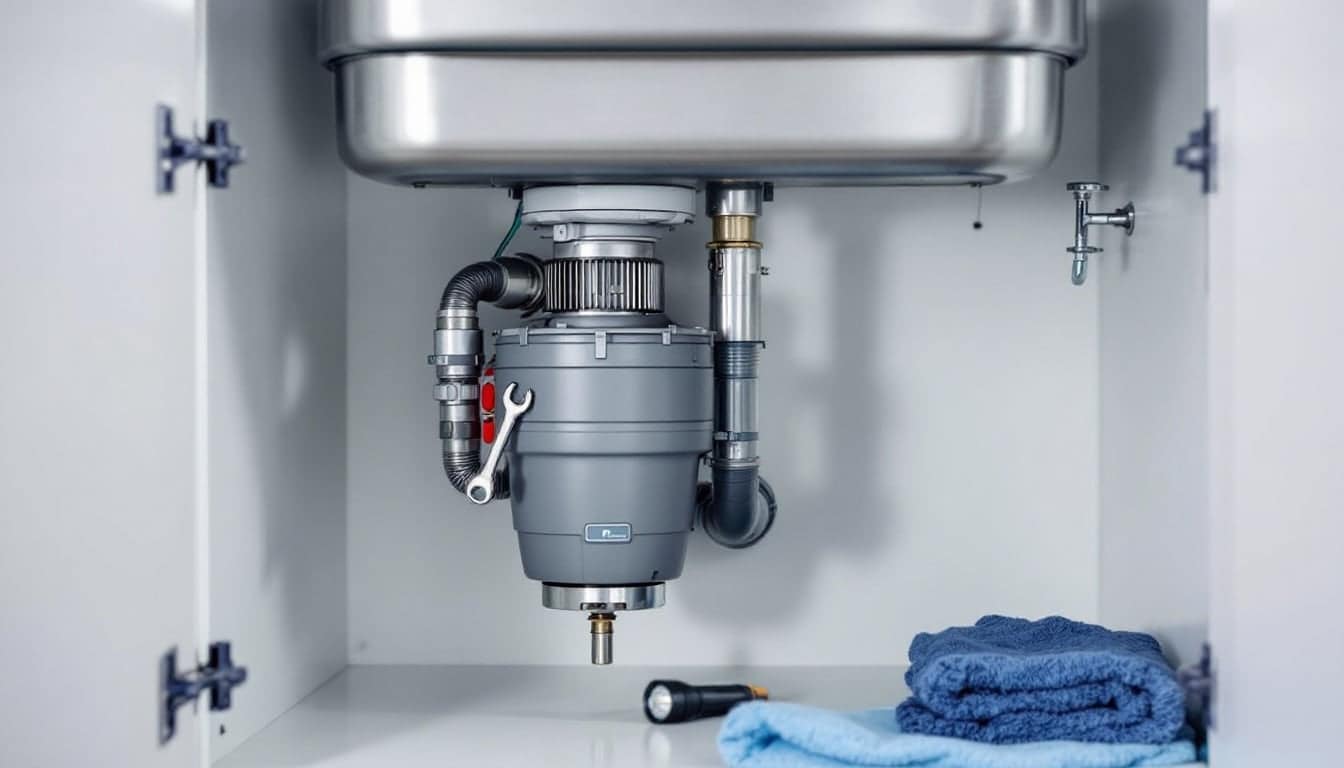
- Find the socket. Look at the very bottom of the disposal, in the centre. There's a small six-sided hole. Most take a 1/4 inch hex key. Many disposals came with an L-shaped wrench for it, which has usually gone missing; a garbage disposal jam wrench or an ordinary 1/4 inch Allen key fits most.
- Work it back and forth. Push the wrench in and rock it. It'll be stiff. Keep working both ways until it suddenly gives and you can turn a full circle freely. That's the plate turning above, and the jam letting go.
- Look in from the top. Flashlight into the chamber. Pull out whatever caused it with tongs or pliers. Fish out any bits of it too.
- Let the motor cool. If it hummed for a while, give it 10 minutes or so.
- Press the reset button (next section).
- Restore power and run cold water. Switch on with the tap running. It should spin up with a normal whirr.
If there's no socket underneath, some older units can be turned from above with a broom handle wedged against one of the lugs. Power off first, always, and work the handle back and forth the same way.
Where is the garbage disposal reset button?
On the bottom of the unit, or low down on the side near the cord. It's a small button, usually red, sometimes black. You may need to crouch and use a flashlight, because it's on the face nobody looks at.
The button is part of a thermal overload switch. When the motor gets too hot, from a jam, a long run or a heavy load, the button pops out a few millimetres and cuts the power. Until you push it back in, the disposal stays silent.
How to reset a garbage disposal
- Switch off at the wall.
- Clear any jam first, or it'll trip again straight away.
- Wait for the motor to cool. A warm motor won't let the button latch.
- Press the button firmly. It should click and stay in. If it springs straight back out, wait another 10 minutes.
- Cold water on, switch on.
A disposal that needs resetting every week is telling you something. It's either being overloaded (big batches of peel, fibrous waste, too little water) or the motor is starting to fail.
Garbage disposal won't turn on
No hum, no click, nothing. Work through these in order, because they go from the most likely to the least.
- Reset button. Even if you don't think it's tripped, press it.
- The plug. Under-sink cupboards are full of bins, bottles and buckets that knock plugs half out of sockets. Push it in firmly. A quick way to check the outlet: plug in a lamp or phone charger.
- The breaker. Find the kitchen or disposal breaker in the panel. A tripped one sits in the middle or off position. Push it fully off, then on. If it trips again straight away, stop and see the box below.
- The GFCI outlet. Kitchen outlets near water are often GFCI-protected, and the reset button may be on a different outlet on the counter that feeds the one under the sink. Press reset on any GFCI outlet nearby.
- Air switch or batch-feed stopper. Some disposals start from a button on the sink deck connected by a thin air tube to a control box under the sink. Check the tube is pushed on and the box is plugged in. Batch-feed models only run with the stopper turned into place.
- The wall switch. Switches wear out. If everything above checks out and there's power at the outlet but the switch does nothing, the switch is the suspect. Replacing it is electrical work, and who may do it varies by state and local rules.
When the motor is dead
Sometimes it really is the disposal. Signs:
- It still hums after the plate turns freely with the wrench.
- It trips the breaker the moment you switch on, every time.
- There's power at the outlet, the reset button is in, and the motor makes no sound at all.
- You smell burning, or see smoke from the unit.
- Water drips from the body of the unit itself, rather than the pipes. Internal seals have failed, and that's usually terminal.
A plug-in disposal with a cord is a reasonable swap for a confident DIYer: it hangs from a mounting ring under the sink and the drain and dishwasher connections come off with simple tools. A new unit of the same type may lock onto the existing ring, but mounting systems differ between makers, so plan to fit the new ring if needed. A hardwired unit means electrical work.
Toolbox
 EasyGarbage disposal jam wrench
A hex wrench that turns the disposal motor shaft from underneath to free a jam.
$6.95 Amazon price, 24 October 2026, 16:33 UTC
Buy on Amazon Medium1/2 HP continuous-feed garbage disposal with cord
A common half-horsepower disposal that comes with a power cord already fitted.
$117.62 Amazon price, 24 October 2026, 16:33 UTC
Buy on Amazon
Product prices and availability are accurate as of the date/time indicated and are subject to change.
Picked from specifications and published reviews, not tested by us.
Keeping it turning
- Run cold water before, during and for about 15 seconds after grinding.
- Feed it gradually. A disposal is not a bin with a motor.
- Keep these out: bones, fruit stones, shells, corn husks, celery strings, onion skins, coffee grounds, pasta, rice and fat. Fibrous waste wraps; starch turns to paste; grease sets further down the pipe.
- If the sink still drains slowly with the motor running fine, the problem has moved into the pipe. The blocked drains guides cover clearing it, and the drain snake vs toilet auger piece explains which tool goes down a kitchen line.
Tools for this job Toolbox: Blocked drains

Owen Pritchard
Owen handles everyday repairs (dripping taps, weak showers, blocked loos) and has firm views on coat hangers, caustic soda and anything sold as "flushable".
General guidance only. Gas, electrical and structural work must be done by a suitably qualified person, and rules differ from country to country.