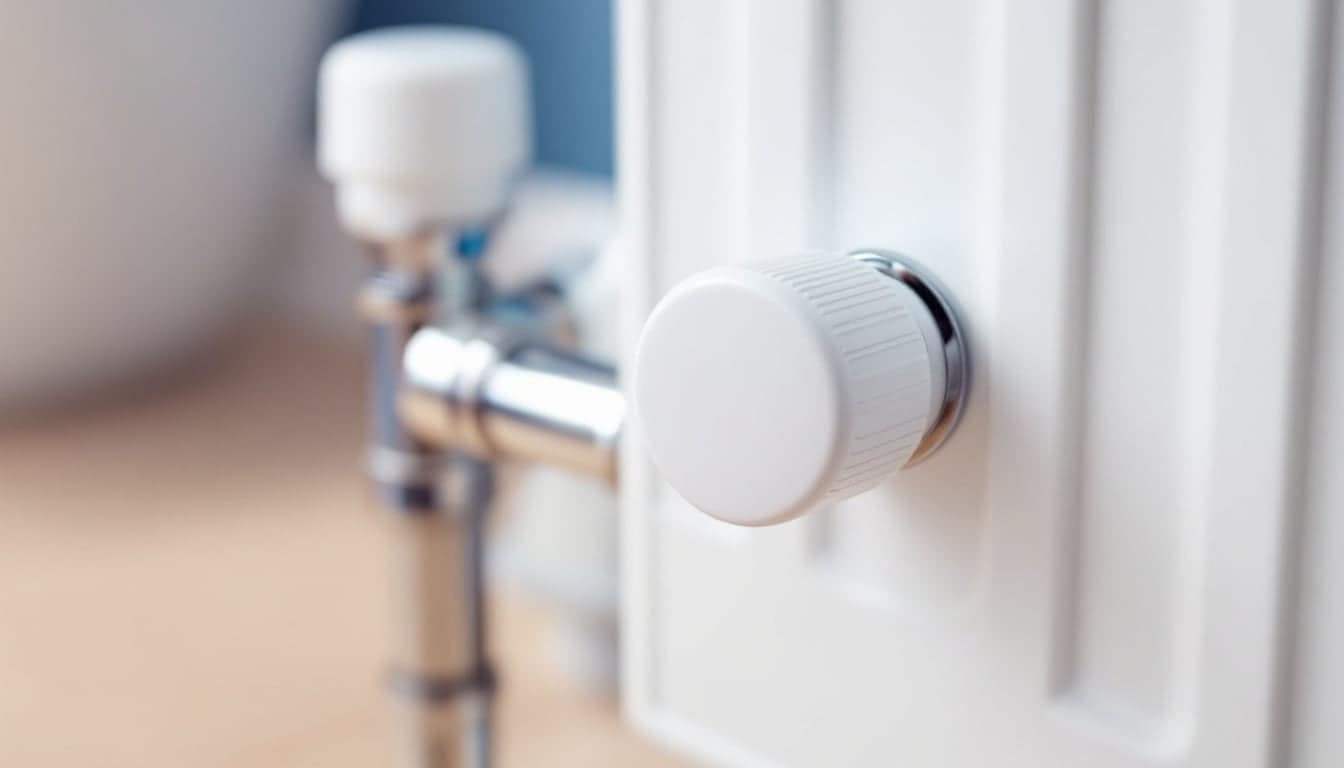
The valve with the numbered head on the side of a radiator looks like a volume knob, and most people use it like one: up when they're cold, down when they're warm. That works, after a fashion, but it isn't what the valve is doing. A thermostatic radiator valve, or TRV, is a small self-contained thermostat. It knows nothing about the boiler and nothing about the time of day. It reads the temperature of the air around its head and opens or closes that one radiator to suit.
Hold on to that idea and most TRV puzzles make sense. More guides on radiators and boilers are collected in the combi boiler and radiator care section.
Some tool links earn us a commission. As an Amazon Associate I earn from qualifying purchases.
What happens inside the head
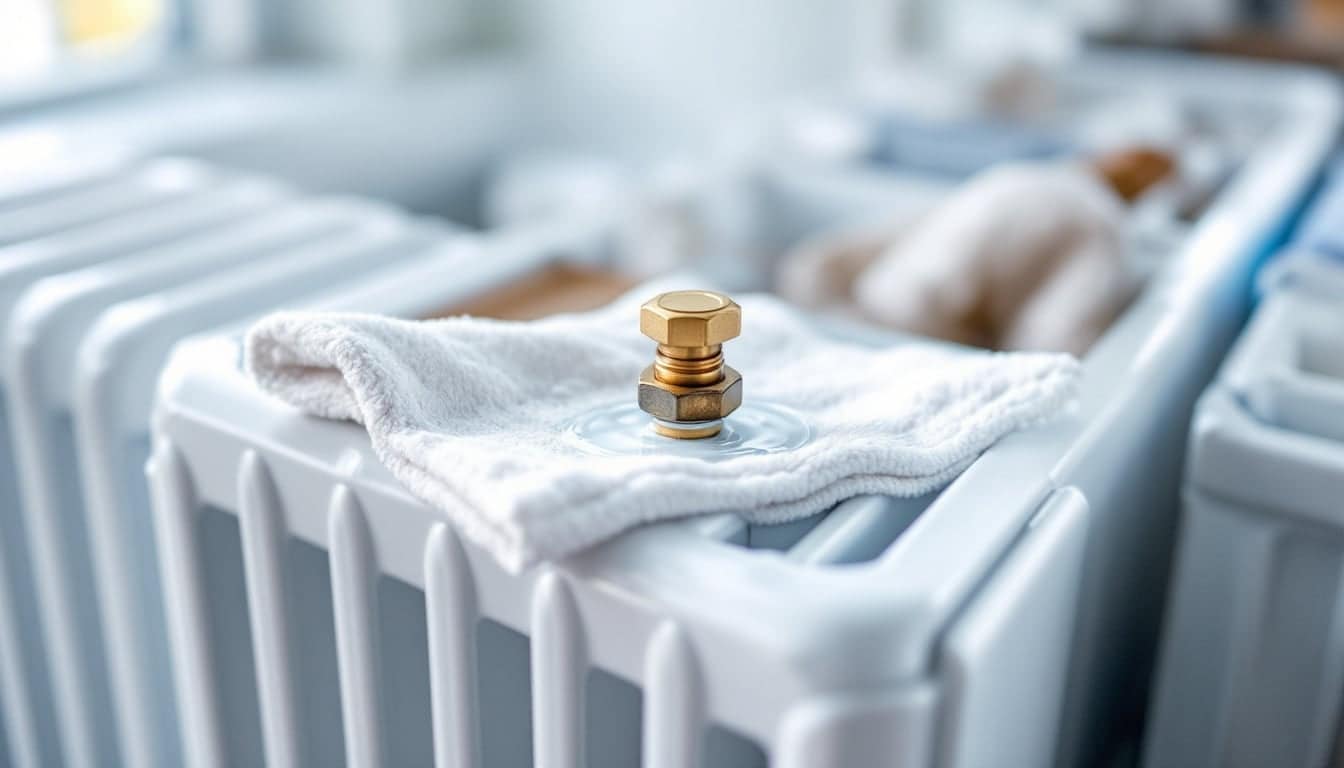
A TRV comes in two parts. The valve body is the brass fitting on the pipe. Sticking up out of the top of it is a small metal pin, held up by a spring. When the pin is up, the valve is open and water flows into the radiator. Push the pin down and the valve closes.
The head screws or clips onto the body and sits over the pin. Inside it is a sensor: a sealed capsule of wax or liquid that expands as it warms. In words, the cycle runs like this:
- Room cold: the sensor contracts, the spring pushes the pin up, the valve opens and hot water flows in.
- Room warming: the sensor expands, pushes a plunger down onto the pin, and the valve starts to close.
- Room at the set temperature: the valve sits almost closed, letting through just enough hot water to hold the room there.
Turning the dial doesn't open or close anything directly. It moves the sensor nearer to or further from the pin, which changes the temperature at which the plunger starts to press. Liquid-filled heads react a little faster than wax ones; both do the same job, with no batteries and no wires.
Because the head senses the air immediately around it, its surroundings matter. Behind a long curtain or boxed in by a sofa, it reads warmer than the room and closes early. Remote-sensor heads on a fine capillary tube exist for exactly that.
The numbers on the dial
Most heads are marked with a frost symbol, then 1 to 5, often with dots or lines in between. The numbers aren't degrees, and the temperature each one corresponds to varies from maker to maker. As a rough guide, many heads behave something like this:
| Setting | Approximate room temperature | Typical use |
|---|---|---|
| Frost symbol | around 5-7°C | Empty rooms and holidays; keeps pipes from freezing |
| 1 | around 10-12°C | Rarely used rooms and stores |
| 2 | around 15-16°C | Bedrooms, for people who sleep cool |
| 3 | around 20°C | Living rooms; the usual comfortable setting |
| 4 | around 23-24°C | Bathrooms, or rooms used by someone who feels the cold |
| 5 | high, close to fully open | Rarely needed for long |
The maker's leaflet has the real figures. In practice, set it to 3, live with it for a day, and adjust by half a number at a time. The frost setting earns its place in spare rooms in winter, and the guide to protecting pipes from freezing explains why it is better than turning a radiator fully off.
Toolbox
 EasyRadiator bleed keys (5-pack)
Small chrome-plated keys that fit the square spindle on most radiator bleed valves, so a cold-topped radiator can be vented in a minute.
$6.95 Amazon price, 19 October 2026, 04:38 UTC
Buy on Amazon EasyInfrared surface thermometer
Point-and-read surface temperatures, handy for finding the cold patch on a radiator, checking flow and return pipes or an underfloor loop.
$18.99 Amazon price, 19 October 2026, 04:38 UTC
Buy on Amazon Easy8-inch adjustable wrench
A mid-size adjustable wrench for supply nuts, shower heads and compression fittings.
$8.99 Amazon price, 19 October 2026, 04:38 UTC
Buy on Amazon
Product prices and availability are accurate as of the date/time indicated and are subject to change.
Picked from specifications and published reviews, not tested by us.
Four common misunderstandings
Turning it to 5 heats the room faster. It doesn't. In a cold room the valve is fully open at 3 and at 5 alike, so the radiator heats at the same speed. On 5 it simply stays open longer and the room overshoots.
A TRV turns the boiler on. A standard TRV has no connection to the boiler at all. The room thermostat or programmer decides when the boiler fires. If the hall thermostat is satisfied, a bedroom TRV turned up to 5 will sit on a cold radiator all evening.
Off means isolated. A head set to 0 closes the valve through the pin, but some don't shut completely, and the pin isn't meant to hold back the system while a radiator is off the wall. Close the lockshield too.
It doesn't matter which pipe it's on. Older TRVs have a flow arrow on the body and belong on the flow pipe; fitted against the arrow, they can hammer as they close. Many modern bodies are bidirectional. If a TRV clatters each time the room warms up, look for the arrow.
The stuck pin, and how to free it
The commonest TRV fault turns up in autumn. Over summer, with the rooms warm, the head holds the pin down for months. Scale and corrosion build up around it, and when the heating comes back on, the pin stays down. The radiator stays cold at every setting, even though the pipe leading to it gets hot.
Freeing it usually takes a few minutes:
- Turn the heating on, so you'll be able to tell when water starts to flow.
- Turn the head to its highest setting. This pulls the plunger back off the pin and makes the head easier to remove.
- Take the head off. Depending on the make, you unscrew a knurled ring, slide back a collar or undo a small grub screw. Put a towel down first, just in case.
- Look at the pin. It should stand a few millimetres proud and spring back up when you press it with a finger.
- If it's stuck down, tap it lightly with the handle of a screwdriver, then grip it gently with pliers and work it up and down a few times. Don't twist it hard or bend it.
- Once it moves freely, the radiator should begin to warm within a few minutes.
- Refit the head at its highest setting, then turn it back to where you want it.
If water weeps from around the pin once it's moving, the small gland seal has worn. Some seals can be renewed; otherwise the valve body needs replacing, which means draining down or freezing the pipe. That's a plumber's job.
To prevent it, turn every TRV to its highest setting when the heating goes off for summer, so the pin rests open.
TRV or lockshield: which end does what
A radiator usually has a valve at each bottom corner. One is the TRV, or on older radiators a simple manual wheelhead valve. That's the one you're meant to touch.
The other is the lockshield: a plain plastic cap that spins freely. Underneath is a spindle that only turns with a spanner or a small lockshield key. It isn't for daily use. Its job is to set, more or less permanently, how much water that radiator can take, so that the system shares the hot water out fairly. Fiddling with it is the quickest way to unbalance a house.
Why one radiator stays cold: balancing basics
Before blaming balance, rule out the simpler causes. A cold band along the top is air, solved by bleeding. A warm top over a cold bottom is usually sludge, described in the guide to radiator flushing. A radiator that stays cold all over while the pipe feeding it is hot is usually a stuck pin.
If none of those fit, and the cold radiators are the ones furthest from the boiler, the system is probably out of balance. Water takes the easiest route, so radiators on short runs near the boiler take a bigger share and the far ones get what's left.
Balancing means partly closing the lockshields on the greedy radiators so the distant ones get more. A simple homeowner version:
- With the heating off and cool, open every TRV fully and every lockshield fully, counting the turns on each lockshield and writing them down.
- Switch the heating on and note the order in which the radiators start to warm.
- Go to the first radiator to warm up. Close its lockshield, then open it a quarter of a turn.
- Work through your list in order, opening each lockshield a little more than the one before.
- Leave the last few radiators, the ones furthest from the boiler, fully open.
- Run the heating for an hour and fine-tune, a little at a time, until every radiator gets properly warm.
Engineers balance more precisely, using clip-on thermometers to measure the drop between flow and return at each radiator. Older guidance quotes about 12°C, but the right target depends on the system's design.
The room without a TRV, and the bypass
Two rules sit behind most TRV layouts.
The first is that the room containing the main room thermostat shouldn't have a TRV controlling its radiator, or, if it has one, it should be set high. If both try to control the same room, the TRV closes first, the room thermostat never sees its target temperature, and the boiler keeps running long after the rest of the house is warm. That room is often the hall or the living room.
The second is about what happens when every TRV in the house closes at once. The pump is still trying to push water round, and many boilers need a minimum flow through them to avoid overheating. That's why a system with TRVs on every radiator needs a bypass: an automatic bypass valve that opens as pressure builds, or one radiator, often a towel rail, left without a TRV so there's always somewhere for the water to go. Many modern boilers have one built in; older systems may need one fitted. Rules on TRVs and bypasses differ between countries, so ask a heating engineer before changing the layout.
Smart TRV heads
Electronic heads replace the wax or liquid sensor with a small battery-powered motor that moves the pin, steered by a thermostat and a schedule, usually through a hub or an app. They let you heat each room only when it's used, and many sense an open window. Some can also call the boiler for heat when any room is cold, which changes the room-thermostat logic above, so follow the system's own setup guidance.
Check that the head fits your valve body, since there are several thread types and adaptors. Expect a faint whirr from the motor, noticeable in a quiet bedroom. A valve-exercise feature, moving the pin every week or so through summer, is useful. A smart head won't free a stuck pin, clear sludge or balance a system, and any wiring at the boiler end is a job for a qualified installer.
Tools for this job Toolbox: Radiators and boilers

Selin Aydemir
Selin writes about central heating: combi boilers, radiators, underfloor loops and the small habits that keep a sealed system running quietly. She likes explaining why a fault happens before saying what to do about it.
General guidance only. Gas, electrical and structural work must be done by a suitably qualified person, and rules differ from country to country.