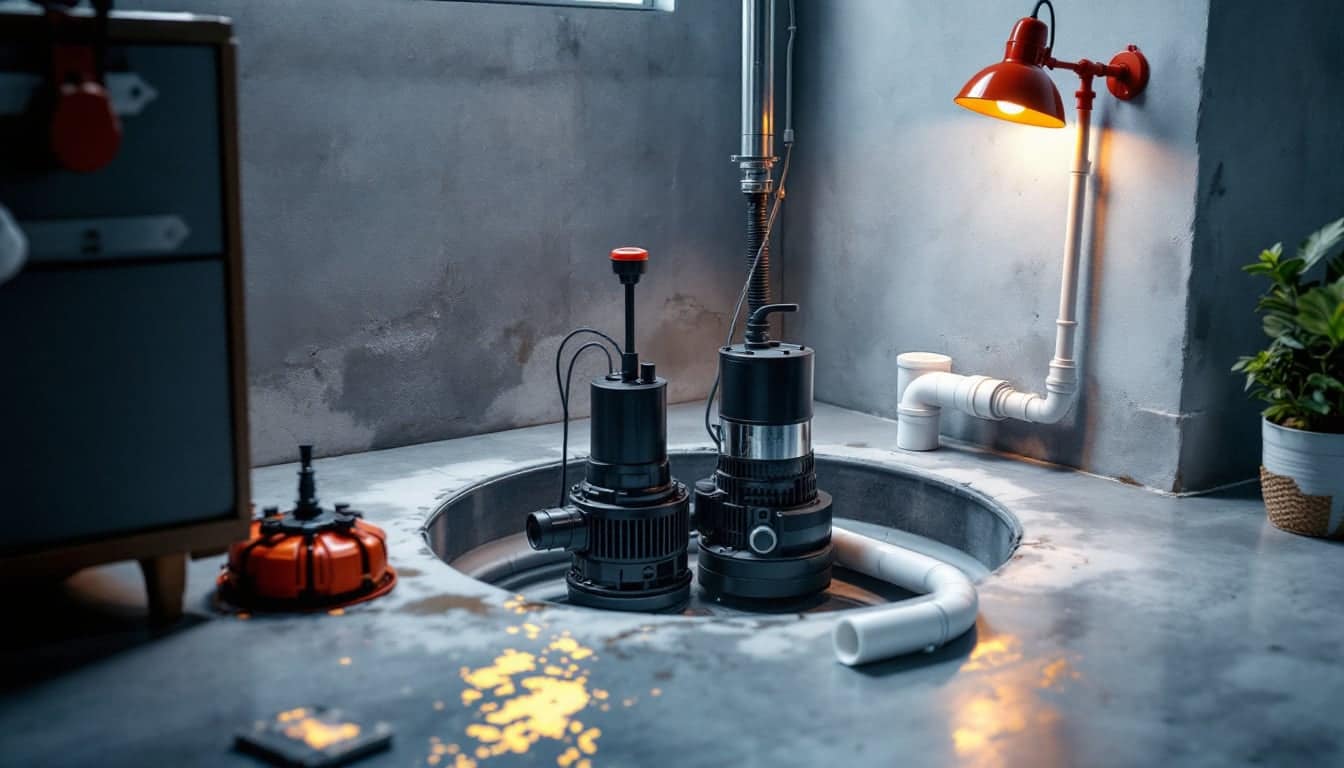
If you're buying a sump pump for a typical basement, the short answer is a 1/3 HP submersible pump with a cast-iron body and a float switch that suits the width of your pit. The figure to compare between pumps isn't horsepower. It's how many gallons per hour the pump moves at your lift, which in many basements is somewhere around 10 feet. Add a sound check valve and an alarm, and most homes are covered.
The harder cases are a high water table, a deep basement, a long discharge run or a narrow pit, where the obvious pick turns out to be the wrong one. This guide shows you which kind of house you have, and where a little more spent on the right part saves a lot spent on a wet floor.
First, check the pump is the answer
If you're replacing a pump that is simply old, skip ahead. If you're shopping because the basement is damp, first work out where the water comes from. Seepage along the joint between wall and floor after rain points to groundwater, which is the pump's job. A damp patch that stays the same through dry weeks, or sits high on a wall, is more likely a leaking pipe or condensation, and no pump will fix it. A pinless moisture meter swept along the walls shows where the damp is concentrated; our guide to using a moisture meter to trace a leak explains the readings.
Submersible or pedestal
| Submersible pump | Pedestal pump | |
|---|---|---|
| Where the motor sits | Sealed, down in the water | On a column above the pit |
| Noise | Quieter, muffled by water and a lid | Louder, motor in the open |
| Pit it suits | Most pits, with a sealed lid | Narrow pits a submersible won't fit |
| Servicing | Lift the pump out | Motor easy to reach |
Most people should buy a submersible: the pit can take a proper lid that keeps out debris and smells, and the noise stays down in the pit. Pedestal pumps have loyal owners because the motor stays dry, but they're louder and the pit stays open. The rest of this guide assumes a submersible.
Horsepower is not the number to compare
Horsepower tells you the size of the motor. The water it moves depends just as much on the impeller and housing, so two 1/3 HP pumps can deliver noticeably different flows at the same lift. The big number on the box is often the flow at 0 feet of lift, which you'll never see in a basement. Roughly: 1/4 HP for light duty, 1/3 HP for a typical basement, 1/2 HP for higher lifts, long runs or a pit that fills fast, and larger only for deep basements with heavy inflow.
How to read a pump curve
The spec sheet or manual has a table or chart of gallons per hour at several lifts, often 5, 10, 15 and 20 feet, plus a shut-off head: the height at which the pump can no longer move any water. To use it:
- Measure the vertical lift from the pit floor to the highest point of the discharge pipe, usually where it passes through the wall or rim joist.
- Add an allowance for friction. A common rule of thumb adds about 1 foot of head for every 10 feet of horizontal pipe, plus a little for elbows and the check valve.
- Read the gallons per hour at that total. If your figure lands near 10 feet, compare every pump on your list at 10 feet.
Your total head should sit well below the shut-off head. A pump working near its limit moves a trickle and runs for long stretches.
Work out how much water you need to move
The most useful number is one you measure yourself, in or just after heavy rain. When the pump switches off, mark the water level on the pit wall, wait one minute and measure how far it has risen. The pump still switches itself on as usual; if it starts before the minute is up, note the seconds instead.
Each inch of rise holds roughly 1.1 gallons in an 18-inch pit and about 2 gallons in a 24-inch pit. Multiply the rise by that figure for gallons per minute, then by 60 for gallons per hour. If you timed a different interval, the flow rate calculator turns gallons and seconds into gallons per minute for you.
Say an 18-inch pit rises 5 inches in a minute: 5 × 1.1 is about 5.5 gallons per minute, or roughly 330 gallons per hour. Choose a pump whose flow at your head is comfortably above that, because the worst storm of the decade will beat the one you measured. If you can't measure, a 1/3 HP pump with a good figure at 10 feet is the sensible default.
Bigger isn't automatically safer. An oversized pump in a small pit empties it in seconds and starts again moments later, and every start heats the motor and wears the switch.
Float switch types
| Switch | How it works | Pit it suits | Watch for |
|---|---|---|---|
| Tethered float | A float on a short cord swings up and turns the pump on | Wider pits | Snagging on the pit wall, cord or pipe |
| Vertical float | A float slides up and down a rod fixed to the pump | Narrow pits | Sticking on the rod as sludge builds |
| Electronic switch | Sensors read the water level, nothing moves | Most pit sizes | Fouled sensors, parts specific to the pump |
A tethered float gives a long pumping range, so the pump starts less often, and the tether length adjusts it. It needs room to swing; the manual gives a minimum pit diameter. A vertical float has a shorter, fixed range and nothing to swing, the usual answer for a narrow pit. Electronic switches have no float to jam, but they're harder to fix yourself.
The switch is one of the most common reasons a pump stops, so check how it's replaced. With a piggyback plug, the pump plugs into the switch's own plug, and a failed switch is a small part rather than a new pump.
For a typical pit, our pick is a 1/3 HP cast-iron submersible sump pump with an automatic float switch. For a narrow pit, look at a 1/3 HP submersible pump with a vertical float.
Pit diameter and depth
Measure the pit's inside diameter and its depth. Many residential pits are about 18 inches across, and some are 24. Check the minimum basin size in each pump's manual against your figures before you order.
A deeper pit holds more water between starts. The pump should switch off before it runs dry, and the turn-on level should sit below the drain tile inlets so water doesn't back up into the tile. Stand the pump on something flat and solid, such as a paver, rather than on gravel or silt it can draw in. If you might add a battery backup later, the pit needs room for two pumps and two floats that can't foul each other.
Cast iron or thermoplastic
Cast iron is heavier and passes motor heat into the surrounding water well, which is why it's the usual choice for a pump that runs often, though the coating can rust after many years. Thermoplastic is lighter, doesn't rust and usually costs less. Plenty of pumps mix the two, so read what the motor housing and impeller are made of.
The money sense is simple. If your pump runs every week of the wet season, the extra for cast iron is well spent. If it runs twice a year, the bigger risk is a switch that sticks from disuse, so a regular check matters more than the body.
Check valve, discharge pipe and alarm
- Pipe size. Most residential pumps have a 1-1/2 inch outlet, and 1-1/2 inch pipe is the usual match. Necking down to a smaller pipe adds friction and cuts the flow you paid for.
- Check valve. It stops the water in the pipe falling back into the pit. Spring-loaded quiet types soften the thump when the pump stops. Fit it with rubber couplings or a union so the pump lifts out without cutting pipe, and replace an old valve along with the pump.
- Weep hole. Many manuals ask for a small hole in the pipe between pump and check valve to stop an air lock. Follow the manual.
- Where the water goes. Well away from the foundation, and never into the sanitary sewer where your town forbids it, as many do. If the outside line can freeze, a freeze-relief fitting at the wall lets water escape when the pipe beyond it ices up; protecting pipes from freezing covers outdoor lines.
- Alarm. A battery water leak alarm on the floor beside the pit sounds the moment water reaches it, whatever the pump or the power is doing.
- Backup. Where storms cut the power, a 12-volt battery backup pump in the same pit, with its own float, takes over when the power or the main pump fails.
Mistakes that cost money
- Choosing on horsepower or the 0-foot flow figure.
- Fitting a tethered float in a pit too narrow for it to swing.
- Oversizing the pump for a small pit, so it short cycles.
- Running the pump from an extension cord instead of its own outlet.
- Waiting for the old pump to fail. Replace a pump of unknown age in a dry week and you choose the pump, rather than grabbing whatever is left on the shelf.
Swapping a like-for-like submersible onto sound pipe with couplings in place is within reach for many owners. Changing the pit, the pipe route or the wiring is not.
FAQ
What size sump pump do I need?
For a typical basement, a 1/3 HP submersible with a good flow figure at about 10 feet of lift. Go larger only when your measured inflow or your lift says so.
How long does a sump pump last?
Many last something like 7 to 10 years, less with heavy use or a sticking switch. If nobody knows how old yours is, plan the replacement now rather than in a storm.
Do I need a battery backup as well?
Not every home does. It earns its place where storms bring power cuts or a wet basement would be expensive, and it needs a pit wide enough for both pumps.
Tools for this job Toolbox: Laundry and basement

Cedric Adebayo
Cedric looks after the seasonal side of a home, from winter-proofing pipes to hard water and maintenance calendars. He also covers the practical business of hiring a tradesperson you can trust.
General guidance only. Gas, electrical and structural work must be done by a suitably qualified person, and rules differ from country to country.