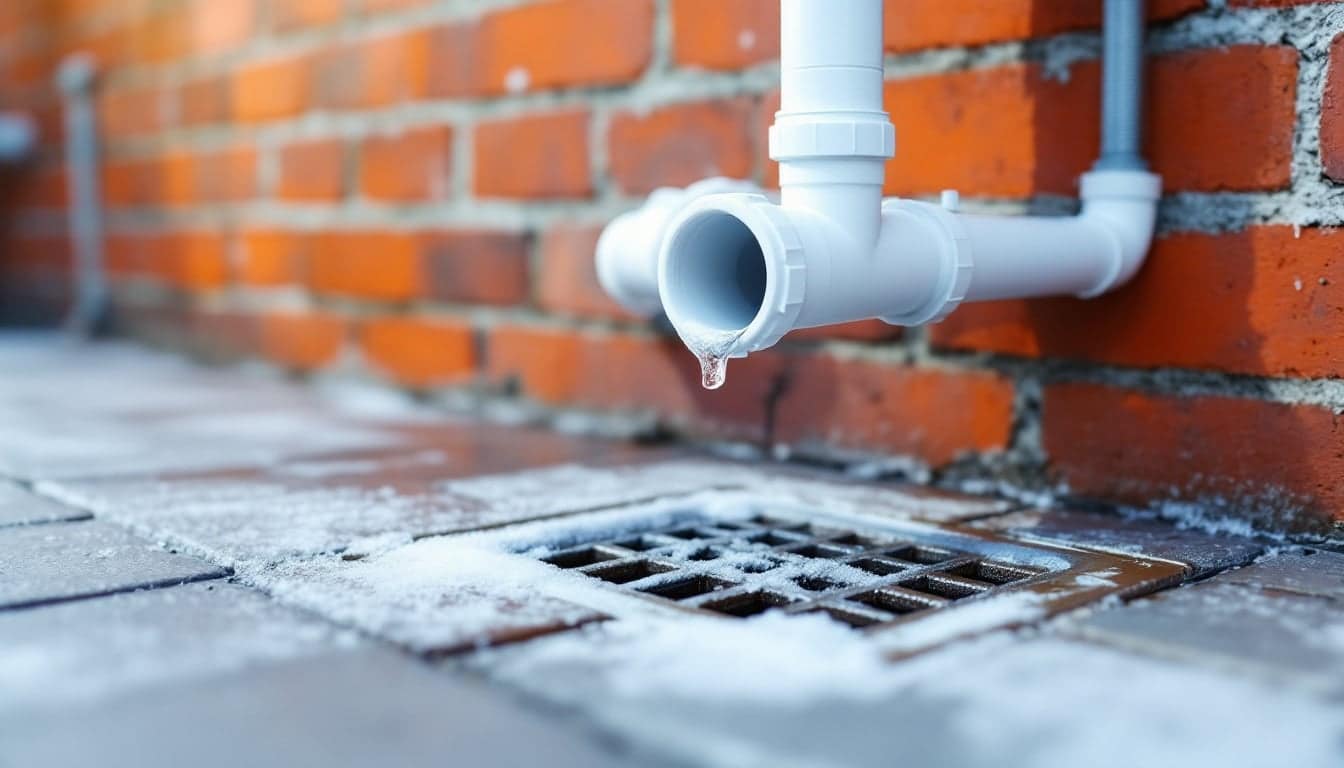
On the first properly cold morning of winter, a lot of households wake up to the same thing: the boiler was fine last night, now it's flashing a fault and won't stay lit. In many of those homes nothing inside the boiler has failed at all. A thin plastic pipe on the outside wall has frozen, and the boiler has shut itself down because the water it produces has nowhere to go.
Our guide to protecting pipes from freezing gives the condensate pipe a short paragraph. This one goes further: why it freezes, how to be sure that's the problem, how to thaw it safely, and what an installer can change so you aren't out in the garden with a jug of warm water every January.
Some tool links earn us a commission. As an Amazon Associate I earn from qualifying purchases.
What a condensate pipe carries
A condensing boiler gets extra heat out of its exhaust gases by cooling them in a second heat exchanger. Once the gases cool enough, the water vapour in them condenses into liquid, the same way your breath fogs a cold window. That liquid is the condensate. It has picked up some of the combustion gases on the way, so it's mildly acidic, often compared to weak vinegar. That's why the pipe is plastic rather than copper, and why it should run to a proper drain rather than onto a flower bed or against brickwork.
On a cold day, with the heating running for hours, the flow is steady. Inside the boiler the condensate collects in a trap, a small U-bend or siphon that stops flue gases escaping down the pipe. When the trap fills, it empties into the condensate pipe, which carries the water by gravity to a drain: a sink waste, a washing machine standpipe, a soil stack inside the house, or an outside gully or soakaway.
The outdoor routes are where nearly all the freezing happens.
Why this pipe freezes first
Your mains pipes are full of water that moves every time someone runs a tap. A condensate pipe carries an intermittent dribble of lukewarm water, is mostly empty, and often runs outside. Five things make it worse.
A long outside run
Every extra metre outdoors gives the condensate more time to cool. A pipe that drops a storey and then runs along the base of the house to a gully at the corner is far more exposed than one that drops straight into a drain below.
A small bore
Indoors, condensate pipes are usually the same size as a sink overflow, around 21.5 or 22 mm in Britain. That's fine in a warm kitchen. Outside, a narrow pipe holds very little water, loses heat quickly, and only needs a short plug of ice to block it completely.
Too little fall
Condensate relies on gravity alone. If the pipe runs almost level, sags between clips or rises anywhere, water sits in the low points, and still water freezes long before moving water does. Clips slip over the years, so even a well-laid pipe can develop a belly.
An open end in the wind
Where the pipe finishes above a gully, the end catches the wind. Drips freeze on the lip and ice builds back up inside until the pipe is sealed. The open end and any bends are the first places to look.
Several cold days in a row
One frosty night rarely does it. The usual pattern is several days below freezing, often with wind against that wall, while the boiler cycles on and off and the condensate sits still between bursts.
Toolbox
 EasySelf-sealing foam pipe covers (6-pack)
Pre-slit foam sleeves with an adhesive seam for pipes in lofts, garages and crawl spaces where they can freeze.
Buy on Amazon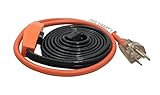 Medium6-foot thermostatic pipe heat cable
A plug-in heating cable with a built-in thermostat that switches on as the pipe nears freezing; for short runs that can't be kept warm another way.
Buy on Amazon EasyInfrared surface thermometer
Point-and-read surface temperatures, handy for finding the cold patch on a radiator, checking flow and return pipes or an underfloor loop.
Buy on Amazon
Picked from specifications and published reviews, not tested by us.
How it shows itself
Most people notice one or more of these:
- The boiler locks out and shows a fault code or a flashing light, typically early on a very cold morning.
- It restarts when you reset it, runs for a few minutes, then stops again.
- A gurgling or bubbling noise comes from the boiler or the pipe as condensate backs up into the trap.
- You can see ice at the end of the pipe, or frost thick along the outside section.
Fault codes differ between manufacturers, and few say "frozen condensate" in plain words. The manual or a label inside the front flap lists them. If the code points to an ignition or flame fault on a freezing morning and the outside pipe is iced up, the condensate pipe is the likely culprit.
Confirm it before you thaw anything
- Find where the pipe leaves the boiler. It's usually white or grey plastic coming from the base of the casing, separate from the copper heating and water pipes.
- Follow it to where it goes. If it joins a sink waste or soil stack inside the house along its whole length, it's unlikely to be frozen and the fault probably lies elsewhere.
- If it passes through an outside wall, go outside and trace the external section to its end.
- Look for ice at the open end and at each bend. Through a glove, a frozen section feels rigid and noticeably colder than the rest.
- Check the drain the pipe empties into. A gully frozen over or packed with leaves will back the pipe up just as surely.
If the pipe runs high on the wall, don't climb a ladder on icy ground. Leave the boiler off and call a heating engineer.
Thawing it safely, step by step
What you need is warmth, patience and some care over where the water ends up.
- Leave the boiler off or in lockout while you work, so it isn't repeatedly trying to restart.
- Prepare warm water. Boil a kettle and let it stand for a while, or use hot water from a tap. You want it hot to the touch, not boiling.
- Start at the open end and the lowest bends, where ice is most likely, then work back up towards the wall.
- Pour slowly along the frozen section, or hold a hot water bottle or heat pack against it. A cloth soaked in warm water and wrapped around the pipe keeps the heat in contact for longer.
- Repeat until water runs out of the end. A stubborn plug may need several jugs.
- Reset the boiler following its manual. On many models that means pressing and holding a reset button for a few seconds.
- Watch it run for 15 to 20 minutes without locking out, and check you can see drips at the drain end.
- Deal with the water you poured. It will freeze on paving in minutes. Mop it up or grit the area so nobody slips.
If the pipe is clear but the boiler still won't restart, check the pressure gauge before anything else; our guide to a combi boiler losing pressure explains what the reading means. Beyond that, the casing stays on and the job goes to a qualified engineer.
What not to do
- Don't use boiling water. It can soften or crack plastic pipe and fittings, and the splash scalds.
- Don't use a blowtorch, a heat gun on a high setting or any naked flame.
- Don't cut or disconnect the pipe to "let it drain". Condensate is acidic, and a pipe that isn't put back properly can let flue gases back through the trap.
- Don't keep pressing reset. Many boilers allow only a limited number of resets before a lockout that needs an engineer to clear.
- Don't pour salt water, antifreeze or de-icer into the pipe.
- Don't stand on a ladder on frozen ground.
Keeping it clear until the cold breaks
Thawing the pipe once won't stop it refreezing that night. For the rest of the cold spell:
- Run the heating steadily rather than in short bursts. Continuous running keeps condensate moving instead of letting it sit in the pipe.
- Wrap the outside section loosely with lagging or an old towel held on with tape, keeping the open end clear.
- Check the end of the pipe each morning and clear any icicle before it builds back inside.
Permanent fixes to ask an installer about
A pipe that freezes every winter is telling you the installation doesn't suit its position. These are jobs for a heating installer. The condensate connection has to follow the boiler manufacturer's instructions and local regulations, and any work on a gas appliance needs someone holding the registration or licence your country requires.
| Fix | What it involves | When it makes sense |
|---|---|---|
| Internal routing | Re-running the pipe indoors to a sink waste, washing machine standpipe or soil stack, with the correct trap and air break | Usually the first choice when a drain is within reach inside |
| Larger bore outside | Increasing the external section to a wider pipe, commonly 32 mm in British guidance | When an outside run can't be avoided |
| Weatherproof insulation | UV-resistant, waterproof lagging along the whole external length | Alongside a larger bore, not as a substitute for it |
| Correct fall and clips | Re-clipping so the pipe falls continuously with no sags or rises | Where the pipe has slumped or was laid too flat |
| Better termination | Cutting the end at an angle and finishing it inside the gully, below the grate but above the water, out of the wind | Where ice keeps forming at the open end |
| Condensate pump | A small pump that lifts condensate to a drain where gravity can't reach | Boilers in basements or far from any drain |
| Trace heating | A thermostatically controlled heating cable along the external section | Long exposed runs that can't be rerouted; the power supply needs a competent electrician |
Rules on pipe size, fall and termination differ between countries, and boiler manuals add their own. Ask the installer which instructions they're working to, and keep the paperwork with your boiler records.
A five-minute autumn check
Before the first frost, go and look at the pipe:
- Trace the whole route from boiler to drain and note how much of it is outside.
- Check every clip is holding and that the pipe falls all the way, with no dips.
- Make sure any lagging outside is intact, dry and covers the run right down to the end.
- Clear leaves and silt from the gully or drain it empties into.
- Find the reset instructions in the boiler manual and leave them somewhere obvious.
It fits alongside the rest of your heating preparation, and our radiator cleaning and combi boiler care guides cover the other jobs worth doing before the radiators go on for the winter.
Tools for this job Toolbox: Winter and outdoor taps

Daniel Okafor
Daniel looks after the seasonal side of a home, from winter-proofing pipes to hard water and maintenance calendars. He also covers the practical business of hiring a tradesperson you can trust.
General guidance only. Gas, electrical and structural work must be done by a suitably qualified person, and rules differ from country to country.