A water pressure regulator for a house, usually sold as a water pressure reducing valve (PRV), earns its place when the supply arriving from the street is higher than household plumbing should carry. If a gauge on an outside tap reads above about 80 psi (5.5 bar) with everything shut off, you almost certainly need one, and many US plumbing codes require it at that point. If it reads 40 to 70 psi, you probably don't, and fitting one would only cost you a little flow.
So the recommendation is short: measure before you buy anything. If the number is high, have a plumber fit a lead-free adjustable valve the same size as your main line, just after the main shut-off, and check at the same visit whether the water heater needs a thermal expansion tank. The rest of this guide explains those choices.
Measure first: the gauge decides
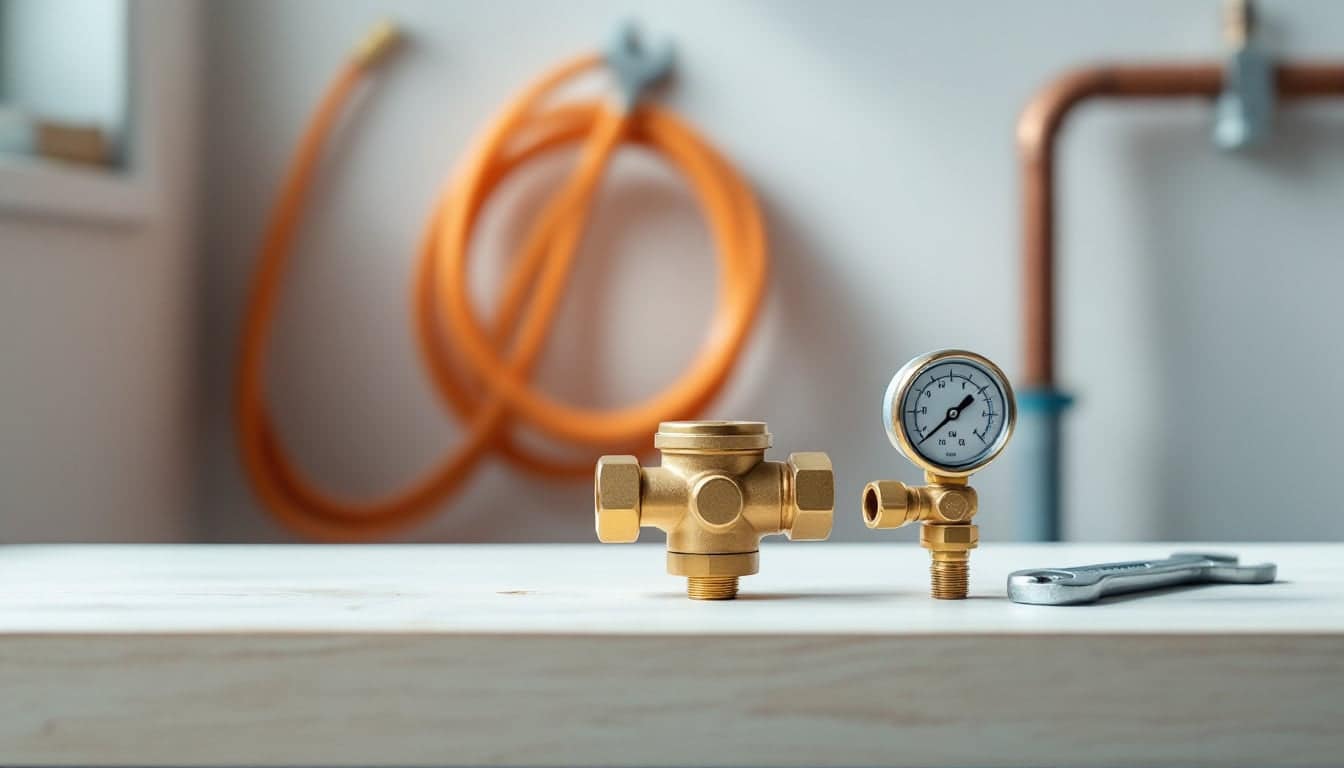
Guessing pressure from the shower is unreliable: a strong shower can come from a good head on a modest 55 psi, a weak one from a scaled mixing valve on 110 psi. A hose-thread water pressure test gauge settles it in five minutes.
- Pick an outside tap or the cold washing machine valve. If the house already has a regulator, make sure the tap is downstream of it.
- Turn off everything that draws water, including an ice maker or a softener in regeneration.
- Screw the gauge on hand-tight, open the tap fully and read the static pressure.
- Read it again late in the evening or early in the morning. Street pressure often rises when demand across the neighbourhood falls, so the overnight figure matters most.
- If your gauge has a red maximum needle, leave it on for 24 hours to record the highest pressure the house saw.
If your appliance manuals quote bar or kPa, the water pressure converter turns the reading into either. Then compare it with this table.
| Static reading (worst time of day) | Approx. bar | Do you need a PRV? |
|---|---|---|
| Under 40 psi | Under 2.8 | No; a regulator lowers pressure, it never raises it |
| 40 to 70 psi | 2.8 to 4.8 | Usually not |
| 70 to 80 psi | 4.8 to 5.5 | Borderline; worth it if fittings drip or hoses fail early |
| Over 80 psi | Over 5.5 | Yes, and many codes require one |
| Maximum needle far above static | Varies | Look at thermal expansion first (see below) |
If the reading is low, a regulator is the wrong purchase; the guide to low water pressure causes covers what to check instead. If the house already has a regulator and still reads high, the existing valve has probably failed, which makes it a replacement job.
Why 80 psi is the line
The 80 psi limit in the model codes has a practical basis. Faucet cartridges, toilet fill valves, appliance inlet valves, supply hoses and water heater fittings are designed around ordinary household pressure. Above it they wear faster and fail in the ways that do the most damage: a burst hose behind a washing machine, a fill valve that never quite shuts, a relief valve that weeps onto the floor.
The other symptom is water hammer, the bang when a valve closes quickly, and it gets louder as pressure rises. If the bang comes from one place only, usually the washing machine or dishwasher snapping its valve shut, a hose-thread water hammer arrestor screwed on between the machine's valve and its fill hose is the targeted cure. It absorbs the shock but leaves the pressure alone, so if pipes knock all over the house and the gauge reads high, the regulator is the real fix.
Types of pressure reducing valve compared
Almost every home uses the same basic design, a direct-acting valve: a spring presses on a diaphragm, and an adjusting screw on top sets the spring force. The differences that matter when choosing are in the extras.
| Feature | What it is | Who should care |
|---|---|---|
| Standard direct-acting valve | Spring, diaphragm and seat in a brass body, with an adjusting screw | Almost every house |
| Integral bypass | A small check that lets water back to the street once house pressure rises above supply pressure | Homes concerned about expansion; not a substitute for a tank |
| Built-in strainer | A mesh screen at the inlet that catches grit before it reaches the seat | Areas where the mains carry sand or scale |
| Replaceable cartridge | The working parts lift out as one unit while the body stays in the pipe | Anyone who wants a quicker repair later |
A bypass only opens once house pressure climbs above street pressure. Where the street supplies 110 psi, the house can still reach 110 psi, which is why codes that call for an expansion tank do not usually accept a bypass instead.
How to choose: size, range and ends
Size: match the line
Buy the valve the same size as the main supply pipe it goes into, usually 3/4 inch in smaller homes and 1 inch in larger ones or where the service line is long. Never downsize to make the fitting easier. Every regulator loses some pressure while water is flowing, known as fall-off, so a valve set to 60 psi static gives noticeably less with two showers and a washing machine running. A valve smaller than the pipe shows more fall-off at exactly the moments you notice it. With many bathrooms or a heavy irrigation draw, a plumber may size it by peak flow instead.
Adjustable range and factory setting
Residential valves are adjustable, commonly across a range of roughly 25 to 75 psi, with the exact span on a tag or cast into the body. Many ship set near 50 psi, but treat that as a starting point and confirm the setting with a gauge after fitting. For most houses a static 50 to 60 psi (3.4 to 4.1 bar) is the target: good showers, and easy on the fittings.
End connections
| End type | How it joins | Notes |
|---|---|---|
| Threaded (female NPT) | Screws onto threaded adaptors | Common on steel or mixed pipework |
| Sweat (solder) | Soldered to copper pipe | Neat and permanent; needs a torch |
| Union ends (single or double) | Nuts clamp the valve between two tailpieces | Easiest to replace later; double union is the most convenient |
| PEX or press ends | Crimp, expansion or press fittings | Matches the plastic or press systems in many newer homes |
Whatever the ends, the valve must be lead-free for drinking water, and it must go in with the arrow on the body pointing in the direction of flow.
Where it goes
The regulator belongs on the main line just after the main shut-off valve, on the house side, before the first branch. One valve then protects every fixture, the water heater included, and you can isolate it yourself. A tidy installation leaves room for a wrench on the unions and often adds a second shut-off on the outlet side, so the valve can be serviced without draining the house.
In warm climates the valve is often outdoors, near where the line rises from the ground or in a box by the meter. If irrigation is teed off before it, the sprinklers stay on street pressure, and a garden tap on that branch will not show the house pressure.
Thermal expansion: the part every quote should mention
A pressure reducing valve does more than lower pressure. Most designs also stop water flowing back towards the street, which turns the house into a closed system. When a tank water heater warms 40 or 50 gallons (151 or 189 litres) of cold water, that water expands, and with nowhere to go it pushes house pressure up, sometimes until the heater's relief valve, commonly set to open at 150 psi, lets some out.
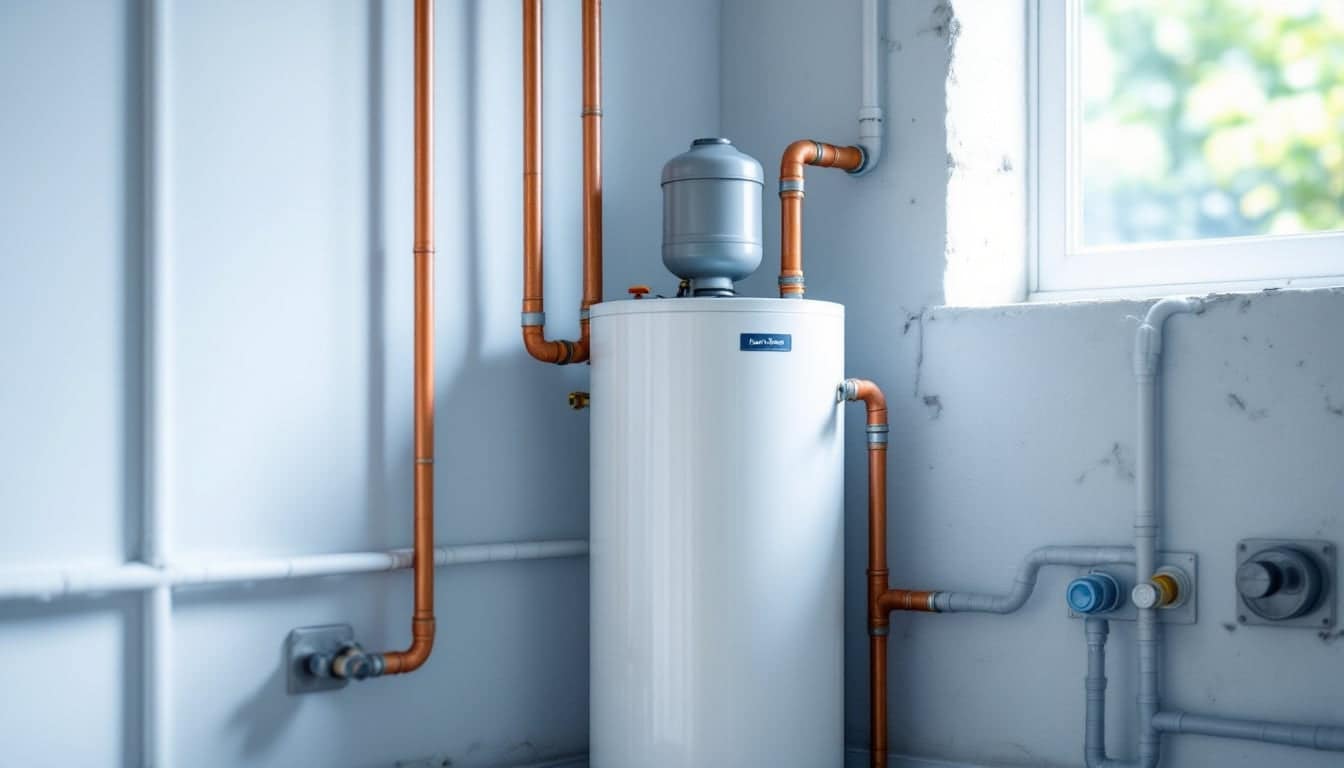
The usual answer is a thermal expansion tank on the cold supply near the heater, with its air charge set to match the house pressure. Many codes require one wherever a regulator or check valve closes the system, and the guide to water heater replacement cost lists it among the parts a plumber checks. If a quote for a regulator does not mention expansion at all, ask about it.
Mistakes to avoid
- Fitting a regulator to cure low pressure. It can only reduce pressure.
- Buying a smaller valve than the pipe. You lose flow under demand.
- Ignoring the maximum needle. A static 60 psi with nightly peaks of 130 psi points to expansion or a valve letting by, not a setting to tweak.
- Breaking the electrical ground. Where metal water pipe forms part of the home's grounding path, electrical codes generally do not want that path to rely on a valve body. A bonding jumper clamped to the pipe either side of the regulator keeps it continuous.
- Capping a dripping relief valve. Never. It is the last line of defence on a water heater.
How long a regulator lasts, and the signs it is going
Many regulators work for ten years or more, fewer where the water is hard or the mains carry grit. The usual signs of a worn valve are pressure creeping towards street pressure with no water in use, pressure that surges and sags while a tap runs, a hum or chatter from the body, water at the bonnet or vent hole, and an adjusting screw that no longer changes the reading. A yearly reading at the same tap and time of day, written on a tag tied to the pipe, catches drift long before a supply hose gives way.
Why a plumber normally fits it
Fitting a regulator means shutting off the main, sometimes at the meter or the street, cutting into the supply, joining the valve with solder, threads or press fittings, then setting and checking the pressure and the expansion arrangements. Some areas want a permit. If you are gathering quotes, the guide to choosing a plumber covers what to ask before you book.
FAQ
Can I fit a home water pressure regulator myself?
If you solder copper competently and can isolate the main, it is possible, but most people should not. A mistake leaves the house without water or with a leak on the main line, and the expansion tank and bonding questions need answering at the same time.
Do I need a pressure reducing valve on a well?
Usually not. A well pump is switched on and off by a pressure switch, typically set somewhere between 30 and 60 psi, so the house never sees street-style pressure.
Work it out Water pressure converter

Kerem Yalçın
Kerem covers leaks, damp and the detective work in between: meter tests, moisture readings and the non-destructive methods used to find a leak without opening every wall.
General guidance only. Gas, electrical and structural work must be done by a suitably qualified person, and rules differ from country to country.