A water pressure regulator, also called a pressure reducing valve or PRV, sits on the main water line and turns high supply pressure down to a level your faucets, hoses and appliances can live with. Most of the time nobody gives it a thought. When pressure in the house creeps up, pipes bang or every shower goes weak at once, it is one of the first things to check, and adjusting it is one of the few main-line jobs a homeowner can reasonably take on.
The adjustment itself takes ten minutes. Measuring before and after is what makes it safe, so the steps below start with a gauge, not a wrench.
What a water pressure reducing valve does
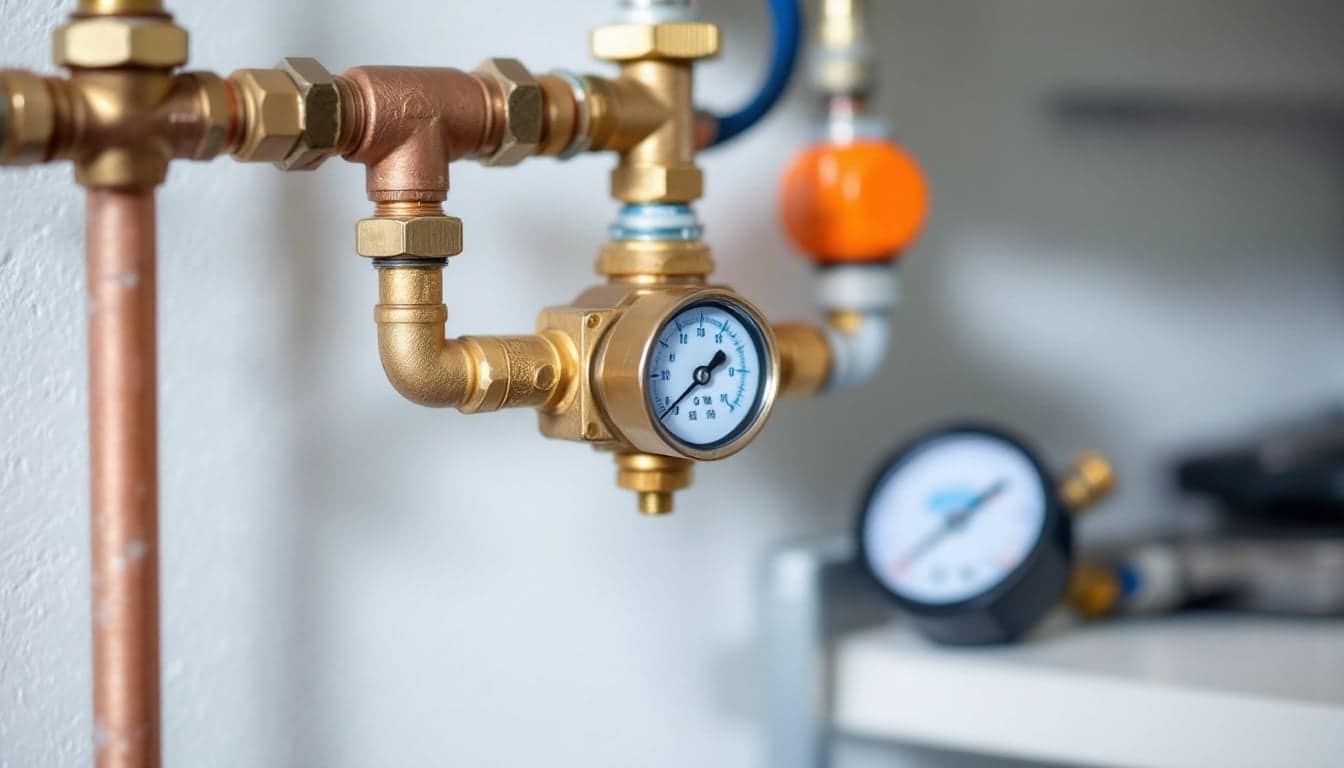
Inside the bell-shaped brass body, a spring presses on a diaphragm linked to a valve. Pressure on the house side pushes back against the spring. When every faucet is shut and the house side reaches the set pressure, the valve closes. When someone opens a faucet and the house-side pressure drops, the spring pushes the valve open again. The adjusting screw on top sets how hard the spring presses: more spring force, higher house pressure.
Regulators are fitted where the supply runs higher than household plumbing should see. Many US plumbing codes set 80 psi (5.5 bar) as the maximum static pressure inside a home and call for a reducing valve when the supply is above that; local codes differ, so check yours. Many valves leave the factory set at around 50 psi (3.4 bar), with the adjustment range printed on the body or on a tag.
Does every house need a water pressure regulator?
No. Where supply pressure is moderate, there may be none, and that is normal. Homes low on a hillside or close to a pumping station tend to receive higher pressure, and those are the ones that usually have a valve. If you cannot find one and your readings are high, ask your water utility what pressure it supplies at your address.
Where to find the home water pressure regulator
Follow the main line from where it enters the house: a basement wall, a crawlspace, the garage or a utility closet. The regulator is usually just after the main shut-off valve, on the house side, and looks like a brass bell or dome roughly the size of a fist, with a screw and locknut on top, sometimes hidden under a cap. In warm climates it is often outside, close to where the line rises from the ground near a hose faucet, or in a box by the meter.
Note which side of the shut-off it sits on. If it comes before your shut-off, you cannot isolate it yourself, and any work on the valve body needs the water turned off at the meter or the street.
Step 1: measure the pressure first
- Choose an outdoor faucet (hose bib) or the cold washing machine connection that is fed from the house side of the regulator. In most homes all of them are, but irrigation lines and some outdoor faucets are teed off before the valve. If a reading looks far too high, check this before blaming the regulator.
- Turn off everything that uses water: faucets, the ice maker, irrigation, a softener mid-regeneration, a toilet that is still filling.
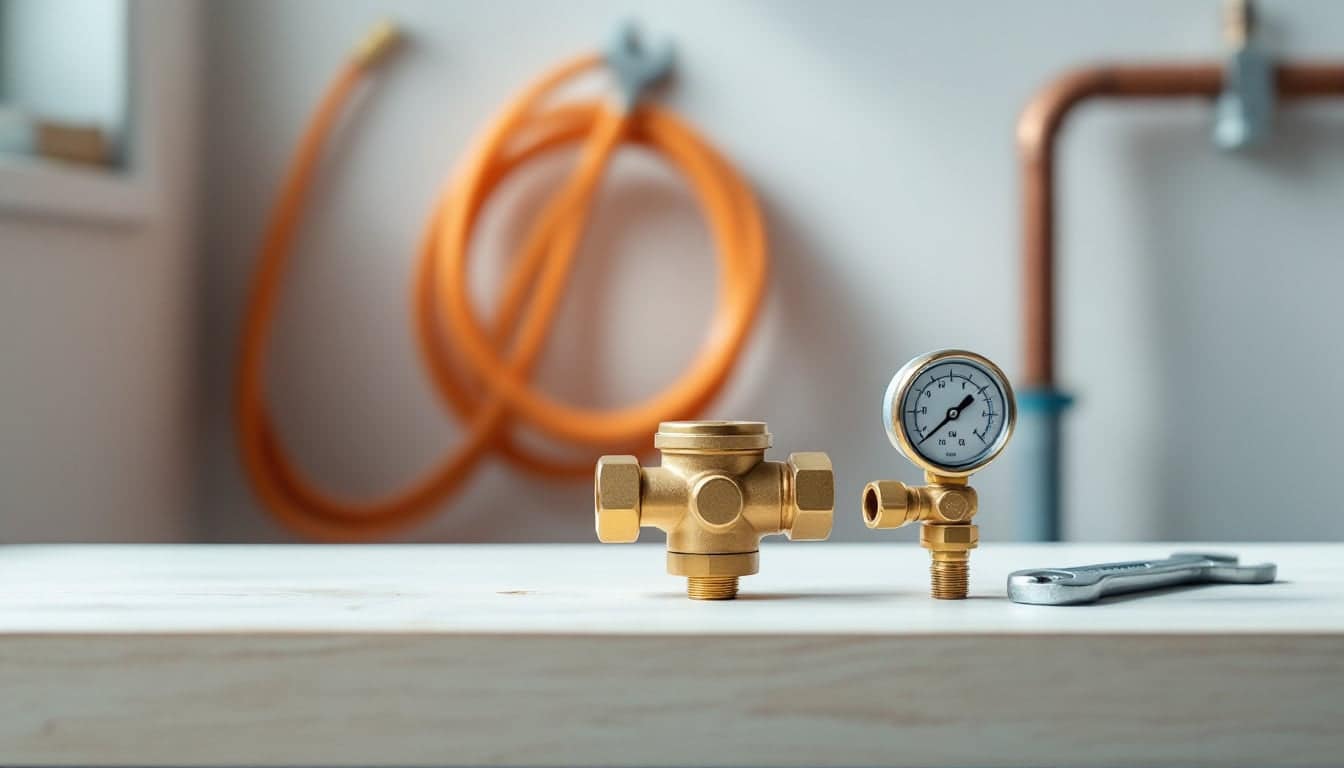
- Screw a water pressure test gauge on hand-tight and open the faucet fully.
- Read the static pressure and write it down with the time.
- If your gauge has a second, maximum needle, leave it on overnight. The next morning it shows whether pressure climbed while nobody was using water, which matters later.
If you think in bar, the water pressure converter turns psi readings into bar and back. Then compare the static reading with these bands:
| Static reading | Approx. in bar | Verdict | What to do |
|---|---|---|---|
| Below 40 psi | Below 2.8 bar | Low | Check the regulator setting, then other causes |
| 40 to 60 psi | 2.8 to 4.1 bar | Normal | Leave it alone |
| 60 to 80 psi | 4.1 to 5.5 bar | High | Turn it down a little |
| Above 80 psi | Above 5.5 bar | Too high | Turn it down; if it won't come down, call a plumber |
Low pressure has plenty of causes besides the regulator, from scaled aerators to corroded pipe, and the guide to low water pressure causes works through them in order.
Step 2: how to adjust a water pressure regulator
- Leave the gauge on the outdoor faucet, with the faucet open, so it keeps reading.
- Take off the cap if there is one. Loosen the locknut on the adjusting screw a turn or two with an adjustable wrench.
- On most regulators, turning the screw clockwise raises the pressure and turning it anticlockwise lowers it. Check the tag or the instructions if you have them.
- Turn the screw a quarter turn, no more.
- Open an indoor faucet for 10 to 20 seconds, then close it. This matters most when lowering the pressure: the higher pressure is trapped in the house pipes and the gauge will not drop until some water is drawn off.
- Read the static pressure again. Repeat a quarter turn at a time until you reach your target.
- Hold the screw still with a screwdriver or a second wrench while you tighten the locknut, so the setting does not move.
- Tie a tag to the pipe with the date, the final reading and which way you turned the screw.
What pressure to set it to
For most homes a static reading of 50 to 60 psi (3.4 to 4.1 bar) gives a good shower without straining anything. Below 40 psi, upstairs showers and some appliances can struggle. Above 60 psi, you gain very little at the faucet and add strain on supply hoses, fill valves and water heater fittings. Some appliances state a working range in their manuals, so check those for anything recently installed.
If a full turn or two makes no difference to the gauge, stop. The valve may be seized, its inlet screen may be blocked, or the supply itself may be low. Winding the screw further does nothing useful and can damage the valve.
Do not raise the whole-house pressure to fix one weak shower. If everything else runs well, the cause is local, usually a clogged aerator or a scaled shower head, and extra pressure only adds strain everywhere else.
Signs of a failing pressure reducing valve
Regulators wear. The seat erodes, the diaphragm stiffens or splits, and grit from the mains lodges where it should not. These are the symptoms that point at the valve:
| What you notice | What it suggests |
|---|---|
| Pressure creeps up overnight, maximum needle well above the setting | The valve is letting supply pressure through, or thermal expansion (see below) |
| Pipes bang when faucets or appliance valves close | Pressure is too high; the hammer gets worse as it rises |
| Faucets drip, toilet fill valves hiss, the water heater relief valve weeps | Sustained high pressure or expansion |
| Sudden low pressure everywhere, adjusting does nothing | Valve stuck or its inlet screen blocked, often after work on the street main |
| Pressure surges and drops while a faucet runs | A sticking valve or tired diaphragm |
| Humming or chattering from the valve body | Internal wear |
| Water from the bonnet or a small vent hole on the valve | A failed diaphragm |
Some regulators have a built-in strainer that can be cleaned, but that means shutting off the supply and opening the valve. If you are not certain your main shut-off works, leave it to a plumber.
Pressure creeping up: thermal expansion
Water expands as it heats. In a house with no regulator or check valve, the extra volume from a tank water heater pushes back into the street main and nobody notices. Most regulators stop water flowing back the other way, which turns the house into a closed system. When the water heater warms a tank of cold water, the extra volume has nowhere to go, so pressure throughout the house rises until someone opens a faucet or the water heater's temperature and pressure relief valve lets some out.
To tell expansion from a leaking regulator, watch the gauge with no water in use. If pressure climbs while the water heater is heating and falls back the moment you open a faucet briefly, that is expansion. If it keeps climbing towards supply pressure even when the heater is idle, the regulator is passing water it should be holding back.
The usual answer to expansion is a thermal expansion tank: a small tank on the cold supply near the water heater, with an air cushion behind a rubber diaphragm that soaks up the extra volume. Many codes require one wherever a regulator or check valve closes the system. Its air charge is set to match the house pressure, so if you change the regulator setting by much, the tank may need resetting too. When the diaphragm fails, the tank fills with water and stops working. The guide to water heater replacement cost lists the expansion tank among the parts a plumber checks when a heater goes in. A relief valve that drips is a warning, and it must never be capped or plugged.
Replacing the valve is a plumber's job
A regulator that will not hold its setting is replaced rather than repaired in most homes. The job means shutting off the main, sometimes at the meter or street, cutting the old valve out or undoing its unions, fitting the new one in the right direction of flow, and setting and checking the pressure afterwards. Soldering or press tools may be involved, and some areas want a permit. The plumber should also check whether the house needs an expansion tank once the new valve is in.
The gauge is the part worth owning yourself. A reading taken once a year, at the same faucet and the same time of day, tells you when the regulator starts to drift, long before a fill valve or supply hose gives way.
Work it out Water pressure converter

Kerem Yalçın
Kerem covers leaks, damp and the detective work in between: meter tests, moisture readings and the non-destructive methods used to find a leak without opening every wall.
General guidance only. Gas, electrical and structural work must be done by a suitably qualified person, and rules differ from country to country.